
Wheelchair pressure mapping
Wheelchair
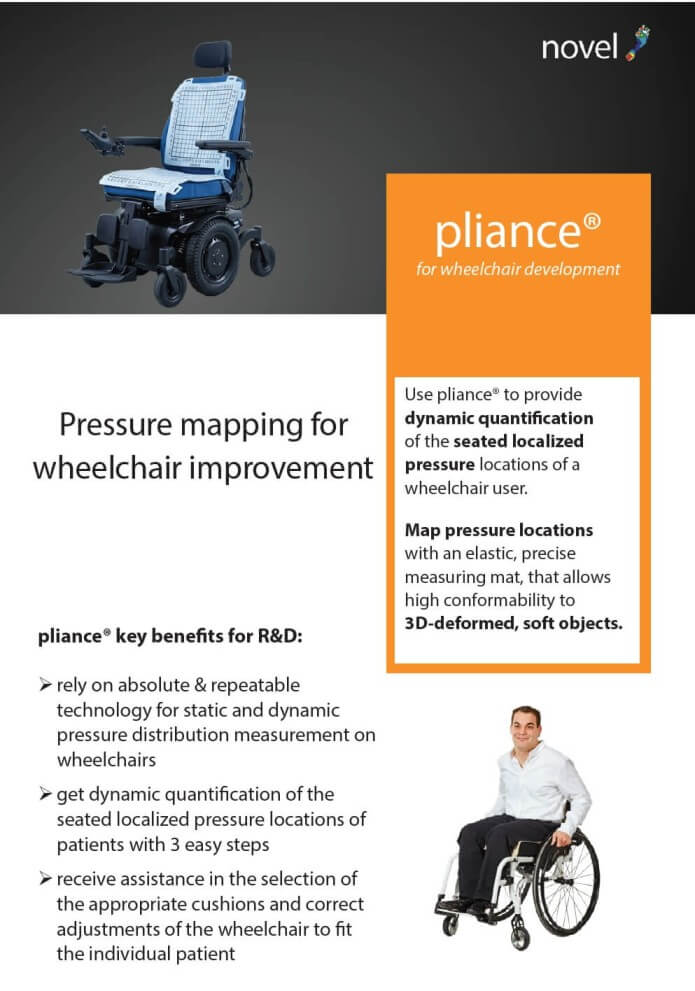
Measure pressure across the wheelchair seat and backrest. Compare cushions and seating adjustments, and record changes while the wheelchair is moving.


Wheelchair pressure mapping
Measure pressure across the wheelchair seat and backrest. Compare cushions and seating adjustments, and record changes while the wheelchair is moving.
01 / The system
The pliance wheelchair system delivers absolute repeatable technology for static and dynamic pressure distribution measurement on wheelchairs. The system provides a dynamic quantification of the seated localized pressure locations of patients in wheelchairs.
The pliance system assists in selecting the appropriate cushions and correct adjustments of the wheelchair to fit the individual patient. For everyday testing, all measurements can be performed dynamically while the wheelchair is moving. The pliance operates via Bluetooth telemetry over a 100 meter range. The telemetry allows the user to watch the patient in the wheelchair and at the same time fully control the pliance system from the PC.

02 / Sensor technology
The system consists of a not only flexible but also elastic measuring mat, a multi-channel analyser, a calibration device and a software package for Windows computers. As in all medical measuring systems the most important part is the sensor technology. pliance works with accurate capacitive transducers in a matrix configuration.
The elasticity of the sensor mats permits perfect conformability to 3-dimensional deformations. The pressure transducing elements contain high-tech materials manufactured by novel. Restoring force, range of force, threshold, hysteresis, temperature effect, frequency response and other characteristics are tailored to optimal use on wheelchairs.
At a glance
01
02
03
03 / Recording and analysis
The pliance software operates as a Windows application and allows easy data collection. It also allows continuous data storage in real-time mode and data handling with a configurable SQL database.
Using novel medical scientific software the expert is able to design the analysis of data to their specific needs and exchange HTML report data with colleagues via intranet or internet connection. Specific reports can be designed by the user to allow quick and easy data analysis and communication.

04 / Package and specifications
View the system components and technical specifications below. Click either image to see the details at full resolution.


05 / Measurement in practice
With the aid of the trublu calibration device, all pliance-HS sensors are individually and simultaneously calibrated with homogeneous air pressure. Calibration guarantees accurate and reproducible data collection.
Watch pliance wheelchair pressure measurement in motion.
novel’s capacitive force sensors could be used in an autonomous wheelchair to detect changes in pressure and weight distribution, which could be used to determine the user’s intended direction of movement. For example, if the user leans forward, the sensors could detect the change in pressure and adjust the wheelchair’s movement accordingly. Additionally, capacitive force sensors could be used to detect obstacles in the user’s path, allowing the wheelchair to navigate around them. Overall, capacitive force sensors could enhance the safety and efficiency of an autonomous wheelchair.
06 / Take a closer look
Tell us about the wheelchair, cushions and seating positions you want to assess. We can help you choose a suitable measurement setup.
 Update cookies preferences