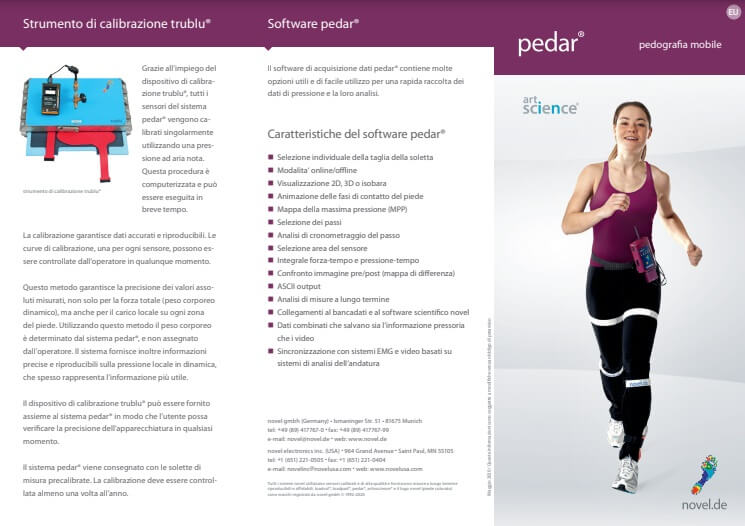
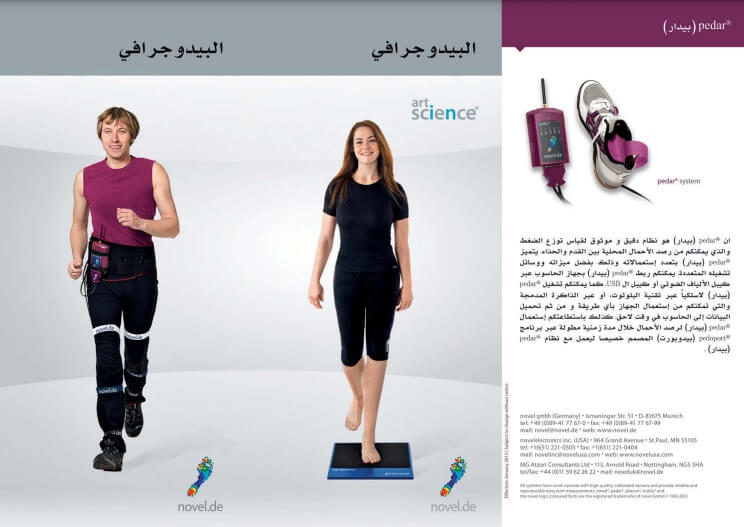
Man walking on a treadmill wearing pedar sensors, with a software monitor behind him in a gait lab

pedar®: Dynamic pressure distribution inside the footwear.

Request a quote ↓

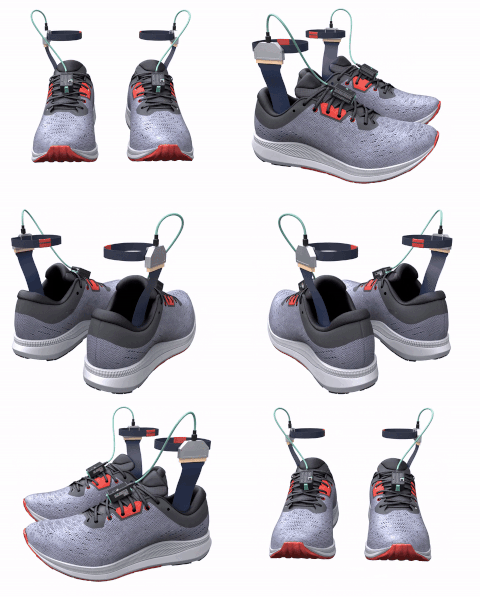
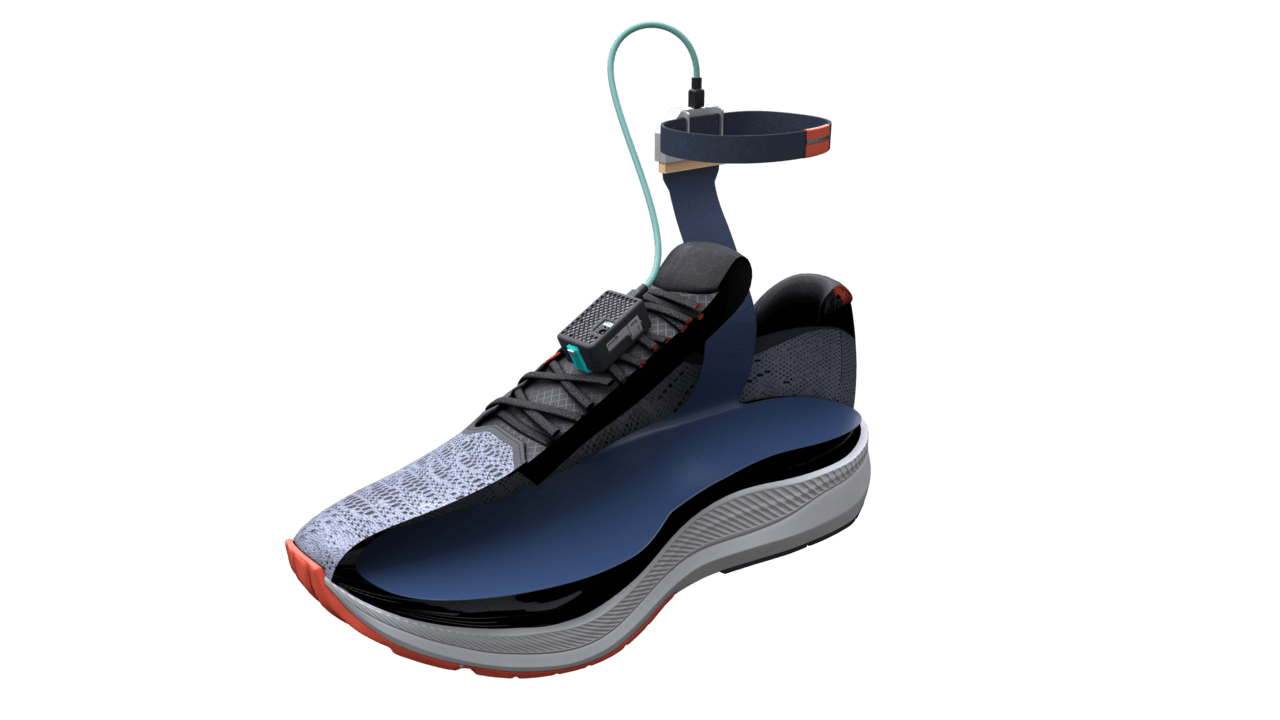
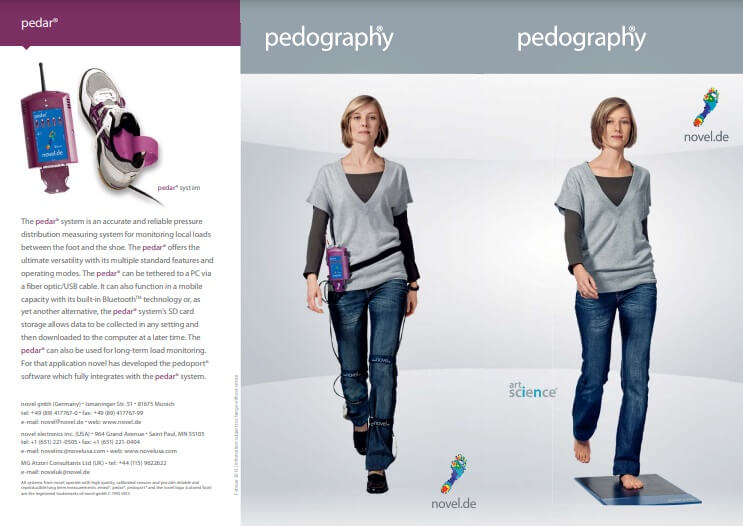
The pedar system is an accurate and reliable pressure distribution measuring system for monitoring local loads between the foot and the shoe. The pedar offers the ultimate versatility with its multiple standard features and operating modes. The pedar utilizes the plidar electronics.  The plidar transmits the pressure data via WiFi to the computer, where it is displayed in real time. It can also store data onboard with 32 GB memory.

54 g of pure efficiency

The system is a tiny, lightweight and easy to use system with:

  • only 54 g matchbox-sized electronics
  • scans 99 sensors up to 400 Hz
  • setup time < 1 min, including mounting the sensors on the subject

All of these features make the pedar system extremely mobile and flexible to meet virtually all testing needs such as walking, running, climbing stairs, carrying loads, playing soccer, or even riding a bicycle. The results are therefore more relevant to real-life.

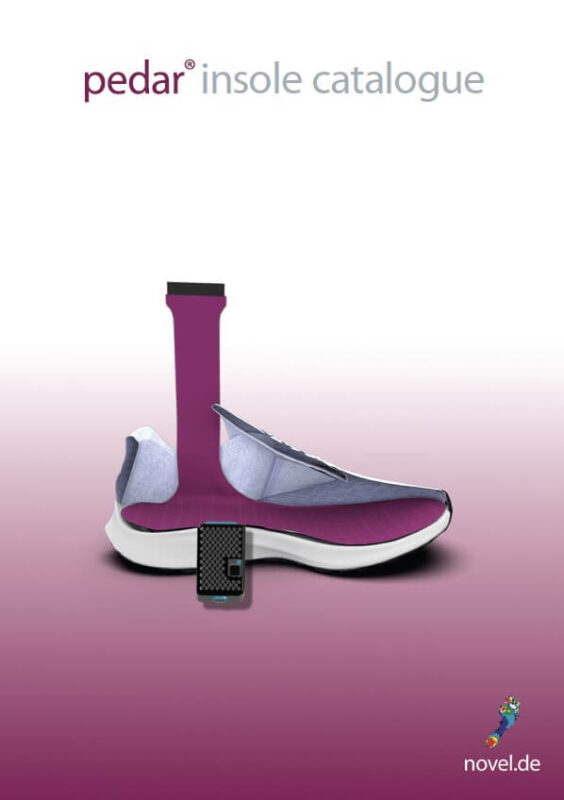
The pedar system connects to highly conforming, elastic sensor insoles that cover the entire plantar surface of the foot, or to sensor pads for the dorsal, medial or lateral areas of the foot.

The pedar system allows multiple synchronisation options to be used i.e. with video systems for gait analysis.

The pedar sensors use capacitive technology – known to provide the best accuracy for pressure measurement on the human body.

Why is capacitive sensing the best choice for research?

Reliability and reproducibility are essential for meaningful research because only consistent and repeatable measurements can support valid scientific conclusions. Insoles using capacitive technology with lower error and higher repeatability—like pedar compared to resistive insoles—provide more trustworthy data for clinical and research use. (As shown in this article)

Applications of pedar system:

Footwear shoe research and design:
It helps optimize footwear design by providing real-time, detailed pressure distribution data to improve comfort, performance, and injury prevention
Diabetic Foot Care:
It helps in monitoring and managing foot health in diabetic patients, particularly those with neuropathy, by identifying high-pressure areas that could lead to ulcers.
Orthopedic Assessments:
Used to evaluate and treat conditions like flat feet, plantar fasciitis, and other musculoskeletal disorders by analyzing pressure distribution and gait patterns.
Post-Surgical Rehabilitation:
Assists in tracking recovery progress and ensuring proper load distribution during rehabilitation after surgeries such as knee or hip replacements.
Sports Medicine and biomechanics:
Helps in optimizing athletic performance and preventing injuries by analyzing foot mechanics during various sports activities.
Prosthetics and Orthotics:
Used to design and adjust prosthetic limbs and orthotic devices to ensure proper fit and function, improving patient comfort and mobility.
Pediatric Assessments:
Assists in diagnosing and treating pediatric foot conditions, ensuring proper development and preventing future issues.

kinetic analysis of free gait in biomechanics

foot pressure measurement by pedar insole

pedar packages:

Different levels of pedar measuring software are available as below:

Software suiteStudio
Pressure distribution measurement✓
Raw pressure data (ASCII)✓
.sol conversion✓
Software suiteExpert
X-Studio included✓
CoP & Step analysis✓
Raw force & CoP data (ASCII)✓
Software suiteExpert
E-Expert included✓
Calibration device✓

Features of pedar system:

  • 99 sensors per insole
  • measurement frequency of  up to 400Hz
  • 70 h of data storage

More details about technical information and different sizes (shoe sizes 22 – 51 EU) are available on pedar insole page.

Features of pedar software:

  • individual sensor selection
  • online and off-line modes
  • pressure picture in 2D, 3D and isobar view
  • numeric display
  • animation of foot contact phases
  • maximum pressure picture (MPP)
  • step selection
  • step timing analysis
  • averaged and individual gait lines
  • comparison and difference pictures
  • calculation of regional loadings
  • ASCII output
  • simultaneous video recording
  • audio feedback for force and pressure values
  • long-term body load analysis
  • integrated into novel databases
  • wide range of scientific analysis software

trublu calibration device

With the aid of the trublu calibration device, all sensors of the pedar system are individually calibrated. Calibration guarantees accurate and reproducible data and can be checked by the user at any time.

WiFi telemetry

The pedar works with a WiFi telemetry system in a wide range. The pedar includes a built-in WiFi system and communicates with various WiFi routers connected to the PC. The telemetry allows the user to watch the subject and at the same time fully control the testing from a PC. The dynamic pressure data can be viewed online and the subject advised how to perform. The system is a perfect tool for teaching and for biofeedback testing.

pedar pad

The pedar pad is a highly flexible sensor for measurements on the dorsal side of the foot inside the shoe. It can be combined with pedar insoles for simultaneous measurement of the plantar and the dorsal aspect of the foot to monitor shoe fit.

Technical data for the pedar pad:
• Number of sensors: 56 (7 x 8)
• Size of one sensor: 10 x 20 mm²
• Sensor area: 70 x 160 mm²
• Pressure range: 15.0 – 600.0 kPa
• Sensor resolution: 0.5 sensor/cm²

Request a quote

pedar pad inside the shoe (dorsal)

Technical specifications analyser:

  dimension (mm) 49 x 31 x 20
  weight (g) 54
  number of sensors (max) 256
  measurement frequency up to 400 Hz
  storage type 32 GB
  computer interface WiFi
  operating system Windows, Mac
  power supply rechargeable and extendable battery

Technical specifications sensor:

 shoe size   22 to 51 (European), 3 widths
 thickness (mm)   1.9 (min. 1)
 number of sensors   99 & 84 (kids) 
 pressure range (kPa)   15 – 600 or 30 – 1,200
 hysteresis (%)   < 7
 resolution (kPa)   2.5 or 5
 offset temperature drift (kPa/K)   < 0.5
 minimal bending radius (mm)   20

Scientific publications:

publication list utilized novel pressure and force measurement sensors

pedar journal articles

Publication years 1996–2026 · Journal articles only

Browse journal articles using pedar. Search by application, title, author, journal or DOI, or open a publication period below.

165journal articles
2024–202627 articles

J001 · 2026

Comparing plantar shear strain in patients with a previous diabetes-related foot ulcer and those at low risk for ulceration using the STrain Analysis and Mapping of the Plantar Surface (STAMPS) system

Jones AD et al. · Diabetic Medicine

Primary application: Diabetic foot

System: pedar-X

Device-use evidence and verification notes

Evidence: Methods explicitly uses pedar-X for pressure measurements and comparison with STAMPS.

Notes: Journal issue 2026; first published online 9 November 2025. Counted once.

J002 · 2026

Design of novel orthotic insoles based on partition infilling of TPMS structures

Lyu Y et al. · Frontiers in Bioengineering and Biotechnology

Primary application: Orthotics

System: pedar-X

Device-use evidence and verification notes

Evidence: Methods sections 2.1.3 and 2.3.2 explicitly report pedar-X standing and walking measurements.

Notes: Published 1 May 2026.

J003 · 2026

Design, mechanical evaluation, and wear trial of 3D printed insole for plantar off-loading in older adults with diabetes

Ning K; Kwan MY; Yick KL · Gait & Posture

Primary application: Diabetic foot

System: pedar-X

Device-use evidence and verification notes

Evidence: Publisher methods identify pedar-X testing of both insoles in sports shoes.

J004 · 2026

Advanced Process Chain for Manufacturing Individual 3D-Printed Insoles for Patients with Diabetic Foot Syndrome

Osterloh J et al. · Applied Sciences

Primary application: Diabetic foot

System: pedar-X

Device-use evidence and verification notes

Evidence: Methods describes recording mean and maximum plantar pressure distributions with pedar at both measurement appointments.

Notes: April 2026; volume 16, issue 8, article 3792.

J005 · 2026

Effect of exertion on the biomechanics of walking with load carriage and running in young, healthy women

Rubio JE et al. · Scientific Reports

Primary application: Biomechanics

System: pedar

Device-use evidence and verification notes

Evidence: Methods reports bilateral pedar plantar-pressure recordings alongside motion capture, ground reaction forces and EMG.

Notes: Published 5 June 2026.

J006 · 2026

Measuring In-Shoe Plantar Strain Outcomes in the Presence of Callus: A Preliminary Study Using the STAMPS3D Measurement System

Sairally F et al. · Journal of Foot and Ankle Research

Primary application: Foot disorders

System: pedar

Device-use evidence and verification notes

Evidence: Full-text methods reports additional walking assessments using pedar for comparison with STAMPS3D.

Notes: First published 13 June 2026.

J007 · 2026

Kalman-Based Joint Analysis of IMU and Plantar-Pressure Data During Speed-Skating Slideboard Training

Wang H et al. · Sensors

Primary application: Speed skating

System: pedar-X

Device-use evidence and verification notes

Evidence: Abstract reports eight skaters wearing pedar-X and IMUs.

Notes: Published 1 January 2026.

J008 · 2026

High-dimensional probability modeling and simulation for restricted crowd walking loads by conditional generative adversarial networks

Xiong J et al. · Results in Engineering

Primary application: Computational modeling

System: pedar-X

Device-use evidence and verification notes

Evidence: Indexed primary methods state that test subjects wore pedar-X insoles.

Notes: Available online July 2026; later issue date may differ.

J009 · 2026

Biomechanical exploration of cushioning and stability in auxetic lattice midsoles during jump landing

Zhang J et al. · Scientific Reports

Primary application: Footwear

System: pedar-X

Device-use evidence and verification notes

Evidence: Methods: pedar-X quantified in-shoe biomechanical parameters across midsole variants.

Notes: Published 27 August 2026.

J156 · 2026

Development of a Novel Modular Footwear Setup for Testing the Isolated Biomechanical Effects of Footwear Features

Sarlak H; Shakir K; Rogati G; Sartorato G; Leardini A; Berti L; Caravaggi P. · Journal of Foot and Ankle Research 19(3):e70203

Primary application: Footwear

System: pedar-X

Device-use evidence and verification notes

Evidence: Ten healthy adults completed walking trials in modular and control footwear. The methods specify pedar-X insoles with 99 capacitive sensors at 100 Hz to measure regional mean and peak pressures across three sessions.

Notes: The footwear setup showed good-to-excellent pressure-measurement repeatability. This evaluates the modular footwear setup, not pedar hardware itself; the Validation & reliability tag is therefore not assigned. The small healthy cohort limits generalization.

J157 · 2026

Comparative Analysis of Plantar Pressure in Walker Boots, Postoperative Shoes, and Standard Shoes

Kim DY; Kyung MG; Kang HW; Kim J; Lee DY. · Clinics in Orthopedic Surgery 18:e44 (online first)

Primary application: Postoperative care

System: pedar-X

Device-use evidence and verification notes

Evidence: Twenty-one healthy men walked in randomized footwear conditions. Pedar-X insoles with 99 sensors at 50 Hz recorded regional forces, pressures and time integrals in walker boots, postoperative shoes and standard athletic shoes.

Notes: The experiment concerns postoperative-footwear applications, but participants were not surgical patients. Different offloading patterns and elevated heel loading concern the footwear, not a negative evaluation of pedar. Contralateral footwear height was not equalized.

J158 · 2026

Pregnancy-related transverse arch deformation: a subject-specific finite element analysis of the contributions of body weight and tissue stiffness

Li X; Lu Z; Fang Y; Fekete G; Sun D; Gu Y. · BMC Pregnancy and Childbirth 26:902

Primary application: Computational modeling

System: pedar (model not specified)

Device-use evidence and verification notes

Evidence: Pedar plantar-pressure measurements during standing were used to check forefoot and heel predictions from the same participant's finite-element foot model in its non-pregnant reference condition.

Notes: Pregnancy-related changes were simulated by varying body weight and tissue stiffness. This is not a pedar measurement study in a pregnant cohort. Pedar supplied reference measurements for model evaluation, rather than being the validation target.

J159 · 2026

AI-Enhanced Modular Material Selection for Patient-Specific Diabetic Insoles via Silicone Molding

Zhang LY; Yick KL; Yip J; Ng SP. · Human Factors 68(10)

Primary application: Diabetic foot

System: pedar (model not specified)

Device-use evidence and verification notes

Evidence: The study used pedar at 50 Hz in 23 adults with type 2 diabetes to compare pressure and contact area during walking in three insole conditions and a sock-secured barefoot reference condition.

Notes: The AI-material insole was compared with PORON and cork-EVA insoles. Overall pressure reduction was similar to PORON; regional effects differed. The controlled, short-term experiment did not establish long-term ulcer prevention. First online 18 April 2026; October 2026 issue.

J160 · 2026

Quantifying differences in high-pressure region mapping between dynamic in-shoe and barefoot plantar pressure in diabetic subjects

Heino D; Telfer S; Nagle-Christensen A; Ledoux WR; Muir BC. · Journal of Biomechanics 199:113201

Primary application: Diabetic foot

System: pedar; emed for separate barefoot measurements

Device-use evidence and verification notes

Evidence: Calibrated pedar insoles, each with 99 sensors, recorded in-shoe walking pressures in standardized extra-depth footwear. Separate emed measurements supplied barefoot maps. The final region-mapping analysis included 25 feet from 16 people with diabetes.

Notes: The study compared measurement conditions, not interchangeable readings from identical setups. Footwear and spatial-resolution differences affect interpretation; some high-pressure regions matched while others differed. This is not classified as pedar-device validation.

J161 · 2026

Comparison of the Effects of Insoles Used in Diabetes Mellitus on Plantar Pressure: A Pilot Study

Mossayebi A; Doğru SC; Shakouri E. · Afyon Kocatepe University Journal of Science and Engineering 26(1):238–248

Primary application: Orthotics

System: pedar (model not specified)

Device-use evidence and verification notes

Evidence: The methods describe pedar insoles with 99 sensors for standing and walking tests with and without insoles. The prefabricated-silicone-insole test is compared with pressure data from three previously published insole studies.

Notes: This is a small pilot comparison incorporating earlier datasets, not a new four-arm clinical trial. Each component study involved one participant; the prefabricated-insole participant was healthy. The diabetic-foot tag describes the design application, not every participant's diagnosis.

J010 · 2025

Comparative Analysis of Pressure Platform and Insole Devices for Plantar Pressure Assessment

Amaro CM et al. · Applied Sciences

Primary application: Measurement methods

System: pedar

Device-use evidence and verification notes

Evidence: Experimental comparison of pedar sensorized insoles with the Physiosensing pressure platform.

J011 · 2025

Effects of the difference foot strike pattern on the plantar pressure during uphill and downhill running

Horiguchi Y et al. · Frontiers in Sports and Active Living

Primary application: Running

System: pedar-X

Device-use evidence and verification notes

Evidence: Methods section 2.2 identifies pedar-X as the pressure and centre-of-pressure measurement device.

J012 · 2025

Computationally tuned dual-layer lattice pads adapted to gait-induced pressure distribution

Lu Z et al. · npj Advanced Manufacturing

Primary application: Computational modeling

System: pedar

Device-use evidence and verification notes

Evidence: Methods identify PEDAR plantar pressure sampling at 100 Hz.

J013 · 2025

Measuring plantar load with STAMPS3D: a preliminary study on the impact of contoured orthoses

Sairally F et al. · Frontiers in Bioengineering and Biotechnology

Primary application: Orthotics

System: pedar

Device-use evidence and verification notes

Evidence: Methods: following STAMPS walking assessments, a final walking assessment used pedar for pressure comparison in the flat condition.

Notes: Published 20 November 2025.

J014 · 2025

Unlocking the multidimensionality of plantar pressure measurements for the evaluation of footwear in people with diabetes

Vossen LE; Bus SA; van Netten JJ · Journal of Biomechanics

Primary application: Diabetic foot

System: pedar

Device-use evidence and verification notes

Evidence: Methods describes pedar insoles in six length sizes fitted inside participants' footwear.

J015 · 2025

Short-Term Efficacy of a Multi-Modal Intervention Program to Improve Custom-Made Footwear Use in People at High Risk of Diabetes-Related Foot Ulceration

van Netten JJ et al. · Journal of Clinical Medicine

Primary application: Diabetic foot

System: pedar-X

Device-use evidence and verification notes

Evidence: Clinical assessment included in-shoe plantar pressure measurement with pedar-X, alongside EMED-X barefoot measurement.

J162 · 2025

The predictive value of cumulative plantar tissue stress on future plantar foot ulceration in people with diabetes—A 12-month prospective observational study

Hulshof CM; van Netten JJ; Busch-Westbroek TE; Sabelis LWE; Peters EJG; Pijnappels M; Bus SA. · Diabetic Medicine 42(10):e70099

Primary application: Diabetic foot

System: pedar-X; emed-X for separate barefoot measurements

Device-use evidence and verification notes

Evidence: In a 60-person high-risk diabetes cohort, pedar-X measured in-shoe pressures during walking and standing in participants' most-used footwear. Emed-X barefoot data, activity monitoring and footwear-adherence measurements contributed to a cumulative tissue-stress metric.

Notes: The combined tissue-stress metric did not predict ulceration over 12 months, although it was associated with pre-ulcerative lesions. This is a null finding about the clinical metric, not a finding that pedar failed or was inaccurate.

J016 · 2024

Center of Pressure Measurement Accuracy via Insoles with a Reduced Pressure Sensor Number during Gaits

Fuchs PX; Chen WH; Shiang TY · Sensors

Primary application: Measurement methods

System: pedar-X

Device-use evidence and verification notes

Evidence: Abstract reports 12 participants wearing pedar-X during three gait tasks.

J017 · 2024

Efficacy of auxetic lattice structured shoe sole in advancing footwear comfort—From the perspective of plantar pressure and contact area

Zhang J et al. · Frontiers in Public Health

Primary application: Footwear

System: pedar-X

Device-use evidence and verification notes

Evidence: Section 3.4 reports Pedar-X (Novel Co., Munich, Germany), 99 sensors, 50 Hz, used during walking and running in four shoe-sole conditions.

Notes: Published 19 June 2024.

J163 · 2024

Design and evaluation of a wedge-shaped adaptive knee orthosis for the human lower limbs

Zhou X; Liu X; Hao J; Liu Y; Tang Y. · Frontiers in Bioengineering and Biotechnology 12:1439616

Primary application: Orthotics

System: pedar (commercial reference insole)

Device-use evidence and verification notes

Evidence: During development of a knee-orthosis pressure-testing system, the authors compared a self-made sensor insole on the right foot with a commercial pedar insole on the left during unbraced walking.

Notes: Pedar served as a reference comparison for another sensing system. The paper does not attribute every subsequent orthosis measurement to pedar; measurements from opposite feet are not a same-foot instrument-agreement test. No pedar validation tag is assigned.

J164 · 2024

Detection of freezing of gait in Parkinson's disease from foot-pressure sensing insoles using a temporal convolutional neural network

Park JM; Moon CW; Lee BC; Oh E; Lee J; Jang WJ; Cho KH; Lee SH. · Frontiers in Aging Neuroscience 16:1437707

Primary application: Parkinson's disease

System: pedar (model not specified)

Device-use evidence and verification notes

Evidence: Pedar insoles with 99 sensors per foot recorded walking pressure at 50 Hz for a neural-network freezing-of-gait detector. Four of 14 recruited participants met the final data-selection criteria.

Notes: The detector showed promising results in this small selected dataset. Transient Bluetooth-recording errors were filtered out; limited freezing episodes also restricted inclusion. This is algorithm development, not broad clinical validation or a claim of error-free recordings.

J165 · 2024

The Stress of Measuring Plantar Tissue Stress in People with Diabetes-Related Foot Ulcers: Biomechanical and Feasibility Findings from Two Prospective Cohort Studies

Hulshof CM; Page M; van Baal SG; Bus SA; Fernando ME; van Gemert-Pijnen L; Kappert KDR; Lucadou-Wells S; Najafi B; van Netten JJ; Lazzarini PA. · Sensors 24(8):2411

Primary application: Diabetic foot

System: pedar-X; emed-X for separate Netherlands-cohort barefoot measurements

Device-use evidence and verification notes

Evidence: Two cohorts used pedar-X at 50 Hz to measure walking pressures in removable offloading devices or regular footwear. The Netherlands cohort also underwent separate emed-X barefoot measurements.

Notes: The multi-device tissue-stress protocol had poor feasibility and incomplete data, leaving the ulcer-healing analysis underpowered. The authors identify validated measurement methods, but also equipment-sharing, cost, technical and participation difficulties; this is not presented as an unqualified success.

2019–202319 articles

J018 · 2023

Evaluation of Different Pressure-Based Foot Contact Event Detection Algorithms across Different Slopes and Speeds

Blades S et al. · Sensors

Primary application: Measurement methods

System: pedar

Device-use evidence and verification notes

Evidence: Article abstract/methods explicitly reports experimental use of the pedar system.

J019 · 2023

3D-Printed Insoles for People with Type 2 Diabetes: An Italian, Ambulatory Case Report on the Innovative Care Model

Mancuso M; Bulzomì R; Mannisi M; Martelli F; Giacomozzi C · Diabetology

Primary application: Diabetic foot

System: pedar-X

Device-use evidence and verification notes

Evidence: Full article reports Pedar-X measurements in the insole assessment procedures.

Notes: Published 17 August 2023; 4(3):339–355. Full-text copy: https://www.researchgate.net/publication/373232153_3D-Printed_Insoles_for_People_with_Type_2_Diabetes_An_Italian_Ambulatory_Case_Report_on_the_Innovative_Care_Model

J020 · 2023

Effects of Midsole Hardness on the Mechanical Response Characteristics of the Plantar Fascia during Running

Zhu X et al. · Bioengineering

Primary application: Running

System: pedar-X

Device-use evidence and verification notes

Evidence: Methods explicitly reports using a pedar-X plantar pressure sensing insole measurement system.

J021 · 2022

Change of In-Shoe Plantar Pressure According to Types of Shoes (Flat Shoes, Running Shoes, and High Heels)

Cho YJ et al. · Clinics in Orthopedic Surgery

Primary application: Footwear

System: pedar-X

Device-use evidence and verification notes

Evidence: Abstract reports peak plantar pressure and pressure-time integral measured using Pedar-X in 27 women.

J022 · 2022

Reliability of the Pedar in-shoe system for plantar pressure measurement in diabetic patients with and without neuropathy: a prospective study

Forogh B et al. · Current Orthopaedic Practice

Primary application: Measurement methods

System: pedar

Device-use evidence and verification notes

Evidence: Article abstract/methods explicitly reports experimental use of the pedar system.

Notes: Online 2021; journal issue 2022.

J023 · 2022

Reducing foot plantar pressure using superelastic nitinol monofilaments as spacer yarns in a novel weft knitted spacer fabric insole

Hamedi M; Salimi P · Journal of Industrial Textiles

Primary application: Orthotics

System: pedar

Device-use evidence and verification notes

Evidence: Primary text describes pedar pressure measurements and regional analyses.

Notes: Published online 22 September 2022.

J024 · 2022

Custom-made footwear designed for indoor use increases short-term and long-term adherence in people with diabetes at high ulcer risk

Keukenkamp R et al. · BMJ Open Diabetes Research & Care

Primary application: Diabetic foot

System: pedar-X

Device-use evidence and verification notes

Evidence: Methods: in-shoe peak plantar pressures were measured dynamically with pedar-X.

J025 · 2022

Does in-shoe pressure analysis to assess and modify medical grade footwear improve patient adherence and understanding? A mixed methods study

McDonogh C et al. · Journal of Foot and Ankle Research

Primary application: Footwear

System: pedar

Device-use evidence and verification notes

Evidence: Methods explicitly describe pedar measurement and pedar-X software.

J026 · 2022

Deep learning approach to estimate foot pressure distribution in walking with application for a cost-effective insole system

Mun F; Choi A · Journal of NeuroEngineering and Rehabilitation

Primary application: Computational modeling

System: pedar-X

Device-use evidence and verification notes

Evidence: Pedar-X supplied ground-truth pressure data for model development and validation.

J027 · 2022

Effects of contoured insoles with different materials on plantar pressure offloading in diabetic elderly during gait

Shi QQ et al. · Scientific Reports

Primary application: Diabetic foot

System: pedar

Device-use evidence and verification notes

Evidence: Methods identify a 99-sensor Pedar system sampled at 50 Hz; insoles were measured across four insole and barefoot conditions.

J028 · 2021

Validation of Plantar Pressure and Reaction Force Measured by Moticon Pressure Sensor Insoles on a Concept2 Rowing Ergometer

Barratt GK et al. · Sensors

Primary application: Rowing

System: pedar-X

Device-use evidence and verification notes

Evidence: Experimental comparison of pedar-X and Moticon in 19 rowers.

J029 · 2021

Clinical foot measurements as a proxy for plantar pressure testing in people with diabetes

Chuter VH et al. · Journal of Foot and Ankle Research

Primary application: Diabetic foot

System: pedar-X

Device-use evidence and verification notes

Evidence: Article abstract/methods explicitly reports experimental use of the pedar system.

J030 · 2021

The Design and Simulation of a 16-Sensors Plantar Pressure Insole Layout for Different Applications: From Sports to Clinics, a Pilot Study

Ciniglio A et al. · Sensors

Primary application: Measurement methods

System: pedar-X

Device-use evidence and verification notes

Evidence: Abstract reports pedar-X data from 39 healthy adults.

J031 · 2021

Foot ulcer recurrence, plantar pressure and footwear adherence in people with diabetes and Charcot midfoot deformity: A cohort analysis

Keukenkamp R et al. · Diabetic Medicine

Primary application: Diabetic foot

System: pedar-X

Device-use evidence and verification notes

Evidence: Methods report dynamic in-shoe plantar pressure measured with Pedar-X at 50 Hz.

Notes: Published online in 2020; journal issue April 2021. Counted once under 2021.

J032 · 2020

Development and evaluation of a dual density insole for people standing for long periods of time at work

Anderson J; Williams AE; Nester C · Journal of Foot and Ankle Research

Primary application: Ergonomics

System: pedar-X

Device-use evidence and verification notes

Evidence: Full-text methods, page 4: pedar-X used to measure plantar pressure in 23 participants.

J033 · 2020

Effect of Tai Chi Training on Plantar Loads during Walking in Individuals with Knee Osteoarthritis

Zhang Z; Huang L; Liu Y; Wang L · BioMed Research International

Primary application: Tai Chi

System: pedar-X

Device-use evidence and verification notes

Evidence: Methods section 2.5 reports pedar-X measurements before and after the intervention.

J034 · 2020

Optimizing footwear for the diabetic foot: Data-driven custom-made footwear concepts and their effect on pressure relief to prevent diabetic foot ulceration

Zwaferink JBJ et al. · PLOS ONE

Primary application: Diabetic foot

System: pedar-X

Device-use evidence and verification notes

Evidence: Methods explicitly states all footwear conditions were tested with pedar-X.

Notes: Published 23 April 2020; accepted in 2019.

J035 · 2019

Effects of a contoured foot orthosis and flat insole on plantar pressure and tibial acceleration while walking in defence boots

Bonanno DR et al. · Scientific Reports

Primary application: Orthotics

System: pedar-X

Device-use evidence and verification notes

Evidence: Abstract explicitly reports Pedar-X plantar pressure measurements in 28 adults across three boot/insole conditions.

J036 · 2019

The Plantar Pressure Analysis of Open Stance Forehand in Female Tennis Players

Chen C; Liang Z; Li S · Physical Activity and Health

Primary application: Tennis

System: pedar-X

Device-use evidence and verification notes

Evidence: Article abstract/methods explicitly reports experimental use of the pedar system.

2013–201836 articles

J037 · 2018

Hardness and posting of foot orthoses modify plantar contact area, plantar pressure, and perceived comfort when cycling

Bousie JA et al. · Journal of Science and Medicine in Sport

Primary application: Cycling

System: pedar-X

Device-use evidence and verification notes

Evidence: Article abstract/methods explicitly reports experimental use of the pedar system.

J038 · 2018

The effects of vibro-medical insole on sensation and plantar pressure distribution in diabetic patients with mild-to-moderate peripheral neuropathy

Cham MB et al. · Clinical Biomechanics

Primary application: Diabetic foot

System: pedar-X

Device-use evidence and verification notes

Evidence: Article abstract/methods explicitly reports experimental use of the pedar system.

J039 · 2018

Plantar Stress-Related Injuries in Male Basketball Players: Variations on Plantar Loads during Different Maximum-Effort Maneuvers

Chen Y et al. · BioMed Research International

Primary application: Basketball

System: pedar Mobile

Device-use evidence and verification notes

Evidence: Article abstract/methods explicitly reports experimental use of the pedar system.

J040 · 2018

Reference values for gait temporal and loading symmetry of lower-limb amputees can help in refocusing rehabilitation targets

Cutti AG et al. · Journal of NeuroEngineering and Rehabilitation

Primary application: Prosthetics

System: pedar-X

Device-use evidence and verification notes

Evidence: Article abstract/methods explicitly reports experimental use of the pedar system.

J041 · 2018

An anatomically-based masking protocol for the assessment of in-shoe plantar pressure measurement of the forefoot

Forghany S et al. · Journal of Foot and Ankle Research

Primary application: Measurement methods

System: pedar-X

Device-use evidence and verification notes

Evidence: Article abstract/methods explicitly reports experimental use of the pedar system.

J042 · 2018

Increasing preferred step rate during running reduces plantar pressures

Gerrard JM; Bonanno DR · Scandinavian Journal of Medicine & Science in Sports

Primary application: Running

System: pedar-X

Device-use evidence and verification notes

Evidence: Article abstract/methods explicitly reports experimental use of the pedar system.

J043 · 2018

Prevalence of ankle equinus and correlation with foot plantar pressures in people with diabetes

Searle A; Spink MJ; Chuter VH · Clinical Biomechanics

Primary application: Diabetic foot

System: pedar-X

Device-use evidence and verification notes

Evidence: Article abstract/methods explicitly reports experimental use of the pedar system.

J044 · 2018

Carrying asymmetric loads while walking on an uneven surface

Wang J; Gillette JC · Gait & Posture

Primary application: Load carriage

System: pedar

Device-use evidence and verification notes

Evidence: Article abstract/methods explicitly reports experimental use of the pedar system.

J045 · 2017

Basketball lay-up – foot loading characteristics and the number of trials necessary to obtain stable plantar pressure variables

Chua YHK et al. · Sports Biomechanics

Primary application: Basketball

System: pedar-X

Device-use evidence and verification notes

Evidence: Article abstract/methods explicitly reports experimental use of the pedar system.

J046 · 2017

Optimisation of rocker sole footwear for prevention of first plantar ulcer: comparison of group-optimised and individually-selected footwear designs

Preece SJ et al. · Journal of Foot and Ankle Research

Primary application: Offloading

System: pedar

Device-use evidence and verification notes

Evidence: Methods describes pedar sensor masks and regional peak pressure calculation across footwear conditions.

J047 · 2017

Validation of Moticon's OpenGo sensor insoles during gait, jumps, balance and cross-country skiing specific imitation movements

Stöggl T; Martiner A · Journal of Sports Sciences

Primary application: Measurement methods

System: pedar-X

Device-use evidence and verification notes

Evidence: Abstract/methods: 16 participants; OpenGo experimentally compared with pedar-X insoles and AMTI force plates.

Notes: Online 24 March 2016; journal issue January 2017.

J048 · 2017

Characteristics of Plantar Loads During Walking in Patients with Knee Osteoarthritis

Zhang Z et al. · Medical Science Monitor

Primary application: Arthritis

System: pedar-X

Device-use evidence and verification notes

Evidence: Methods explicitly uses Novel pedar-X system and its software to analyze regional plantar loading.

J049 · 2016

Total contact cast wall load in patients with a plantar forefoot ulcer and diabetes

Begg L et al. · Journal of Foot and Ankle Research

Primary application: Diabetic foot

System: pedar

Device-use evidence and verification notes

Evidence: Article abstract/methods explicitly reports experimental use of the pedar system.

J050 · 2016

Foot-type analysis and plantar pressure differences between obese and nonobese adolescents during upright standing

Cimolin V et al. · International Journal of Rehabilitation Research

Primary application: Obesity

System: pedar-X

Device-use evidence and verification notes

Evidence: Article abstract/methods explicitly reports experimental use of the pedar system.

J051 · 2016

The effect of foot orthoses with forefoot cushioning or metatarsal pad on forefoot peak plantar pressure in running

Hähni M et al. · Journal of Foot and Ankle Research

Primary application: Running

System: pedar-X

Device-use evidence and verification notes

Evidence: Article abstract/methods explicitly reports experimental use of the pedar system.

J052 · 2016

Effects of custom-made textile insoles on plantar pressure distribution and lower limb EMG activity during turning

Lo WT et al. · Journal of Foot and Ankle Research

Primary application: Orthotics

System: pedar-X

Device-use evidence and verification notes

Evidence: Article abstract/methods explicitly reports experimental use of the pedar system.

J053 · 2016

Validity and repeatability of three in-shoe pressure measurement systems

Price C; Parker D; Nester C · Gait & Posture

Primary application: Measurement methods

System: pedar

Device-use evidence and verification notes

Evidence: Experimental comparison of pedar, Medilogic and Tekscan.

J054 · 2016

Relationships between static foot alignment and dynamic plantar loads in runners with acute and chronic stages of plantar fasciitis: a cross-sectional study

Ribeiro AP et al. · Brazilian Journal of Physical Therapy

Primary application: Running

System: pedar-X

Device-use evidence and verification notes

Evidence: Article abstract/methods explicitly reports experimental use of the pedar system.

J055 · 2015

Data-driven directions for effective footwear provision for the high-risk diabetic foot

Arts MLJ et al. · Diabetic Medicine

Primary application: Diabetic foot

System: pedar-X

Device-use evidence and verification notes

Evidence: Article methods identify pedar-X in-shoe pressure measurements used to assess footwear modifications.

J056 · 2015

Dynamic Patterns of Forces and Loading Rate in Runners with Unilateral Plantar Fasciitis: A Cross-Sectional Study

Ribeiro AP et al. · PLOS ONE

Primary application: Running

System: pedar-X

Device-use evidence and verification notes

Evidence: Methods: 45 runners with plantar fasciitis and 30 controls ran wearing pedar-X insoles.

J057 · 2014

Plantar pressure analysis of accommodative insole in older people with metatarsalgia

Chang BC et al. · Gait & Posture

Primary application: Orthotics

System: pedar

Device-use evidence and verification notes

Evidence: Article abstract/methods explicitly reports experimental use of the pedar system.

Notes: Online 2013; journal issue 2014.

J058 · 2014

Test-retest reliability of an insole plantar pressure system to assess gait along linear and curved trajectories

Godi M et al. · Journal of NeuroEngineering and Rehabilitation

Primary application: Measurement methods

System: pedar-X

Device-use evidence and verification notes

Evidence: Article abstract/methods explicitly reports experimental use of the pedar system.

J059 · 2014

Introduction of a neutral shoe to assess reference values for dynamic pedobarography

Kluger AK et al. · Biomedical Engineering / Biomedizinische Technik

Primary application: Measurement methods

System: pedar-X

Device-use evidence and verification notes

Evidence: Article abstract/methods explicitly reports experimental use of the pedar system.

J060 · 2014

Effects of shoe sole hardness on plantar pressure and comfort in older people with forefoot pain

Lane TJ et al. · Gait & Posture

Primary application: Footwear

System: pedar-X

Device-use evidence and verification notes

Evidence: Article abstract/methods explicitly reports experimental use of the pedar system.

Notes: Online 2013; journal issue 2014.

J061 · 2014

Risk Factors for Plantar Foot Ulcer Recurrence in Neuropathic Diabetic Patients

Waaijman R et al. · Diabetes Care

Primary application: Diabetic foot

System: pedar-X

Device-use evidence and verification notes

Evidence: Methods reports dynamic in-shoe plantar pressure assessments at study visits with pedar-X; insoles calibrated every three months.

J062 · 2014

The effects of running cadence manipulation on plantar loading in healthy runners

Wellenkotter J; Kernozek TW; Meardon S; Suchomel T · International Journal of Sports Medicine

Primary application: Running

System: pedar-X

Device-use evidence and verification notes

Evidence: Author full text identifies Pedar-X measurements in 38 treadmill runners under three cadence conditions.

Notes: Device-use evidence: author full text at https://www.academia.edu/23590317/The_Effects_of_Running_Cadence_Manipulation_on_Plantar_Loading_in_Healthy_Runners

J063 · 2014

Influence of in-shoe heel lifts on plantar pressure and center of pressure in the medial-lateral direction during walking

Zhang X; Li B · Gait & Posture

Primary application: Orthotics

System: pedar

Device-use evidence and verification notes

Evidence: Article abstract/methods explicitly reports experimental use of the pedar system.

J064 · 2014

Variation in the location of the shoe sole flexion point influences plantar loading patterns during gait

van der Zwaard BC et al. · Journal of Foot and Ankle Research

Primary application: Footwear

System: pedar

Device-use evidence and verification notes

Evidence: Abstract reports Pedar plantar pressure measurements in 21 women wearing three different shoe conditions.

J065 · 2013

The effect of prefabricated and proprioceptive foot orthoses on plantar pressure distribution in patients with flexible flatfoot during walking

Aminian G et al. · Prosthetics and Orthotics International

Primary application: Orthotics

System: pedar-X

Device-use evidence and verification notes

Evidence: Article abstract/methods explicitly reports experimental use of the pedar system.

Notes: Online 2012; journal issue 2013.

J066 · 2013

Contoured in-shoe foot orthoses increase mid-foot plantar contact area when compared with a flat insert during cycling

Bousie JA et al. · Journal of Science and Medicine in Sport

Primary application: Cycling

System: pedar

Device-use evidence and verification notes

Evidence: Article abstract/methods explicitly reports experimental use of the pedar system.

Notes: Online 2012; journal issue 2013.

J067 · 2013

Effect of custom-made footwear on foot ulcer recurrence in diabetes: a multicenter randomized controlled trial

Bus SA et al. · Diabetes Care

Primary application: Diabetic foot

System: pedar-X

Device-use evidence and verification notes

Evidence: In-shoe plantar pressures assessed using pedar-X at delivery and follow-up visits.

J068 · 2013

Learning from experience: A simple effective protocol to test footwear prescriptions for the Diabetic foot by using the Pedar system

Giacomozzi C; Uccioli L · Journal of Biomedical Science and Engineering

Primary application: Diabetic foot

System: pedar

Device-use evidence and verification notes

Evidence: Article text reports volunteers equipped with the Pedar Insole System for reference measurements.

Notes: Method/protocol article with volunteer reference measurements, not merely a protocol for future data collection.

J069 · 2013

The effect of removing plugs and adding arch support to foam based insoles on plantar pressures in people with diabetic peripheral neuropathy

Lin TL et al. · Journal of Foot and Ankle Research

Primary application: Diabetic foot

System: pedar

Device-use evidence and verification notes

Evidence: Article abstract/methods explicitly reports experimental use of the pedar system.

J070 · 2013

The effect of customised and sham foot orthoses on plantar pressures

McCormick CJ et al. · Journal of Foot and Ankle Research

Primary application: Orthotics

System: pedar-X

Device-use evidence and verification notes

Evidence: Article abstract/methods explicitly reports experimental use of the pedar system.

J071 · 2013

The effects of different shoes on plantar forces in Irish dance

Trégouët P; Merland F · Journal of Dance Medicine & Science

Primary application: Irish dance

System: pedar

Device-use evidence and verification notes

Evidence: Article abstract/methods explicitly reports experimental use of the pedar system.

J072 · 2013

Plantar pressure and daily cumulative stress in persons affected by leprosy with current, previous and no previous foot ulceration

van Schie CHM et al. · Gait & Posture

Primary application: Leprosy

System: pedar-X

Device-use evidence and verification notes

Evidence: Article abstract/methods explicitly reports experimental use of the pedar system.

2007–201243 articles

J073 · 2012

In-shoe center of pressure: indirect force plate vs. direct insole measurement

Debbi EM et al. · The Foot

Primary application: Measurement methods

System: pedar-X

Device-use evidence and verification notes

Evidence: Article abstract/methods explicitly reports experimental use of the pedar system.

J074 · 2012

Comparison of plantar loads during treadmill and overground running

Hong Y et al. · Journal of Science and Medicine in Sport

Primary application: Running

System: pedar

Device-use evidence and verification notes

Evidence: Abstract: plantar loads collected using a Novel pedar insole sensor system.

J075 · 2012

Reduction of peak plantar pressure in people with diabetes-related peripheral neuropathy: an evaluation of the DH Pressure Relief Shoe™

Raspovic A; Landorf KB; Gazarek J; Stark M · Journal of Foot and Ankle Research · 5:25

Primary application: Diabetic foot

System: pedar-X

Device-use evidence and verification notes

Evidence: Full-text methods explicitly identify the in-shoe pedar-X system (Novel GmbH), 99-sensor insoles, 50 Hz sampling and calibration with trublu before measurement.

Verification basis: Primary full-text methods

Application: Diabetic peripheral neuropathy; offloading shoes

Publication date: Published 1 October 2012.

Notes: Sixteen participants were recruited and fourteen included in analysis.

J076 · 2011

Influence of patellofemoral pain syndrome on plantar pressure in the foot rollover process during gait

Aliberti S et al. · Clinics

Primary application: Knee pain

System: pedar-X

Device-use evidence and verification notes

Evidence: Article abstract/methods explicitly reports experimental use of the pedar system.

J077 · 2011

Twelve steps per foot are recommended for valid and reliable in-shoe plantar pressure data in neuropathic diabetic patients wearing custom made footwear

Arts MLJ; Bus SA · Clinical Biomechanics

Primary application: Measurement methods

System: pedar-X

Device-use evidence and verification notes

Evidence: Article abstract/methods explicitly reports experimental use of the pedar system.

J078 · 2011

Harmful cleats of football boots: a biomechanical evaluation

Bentley JA et al. · Foot and Ankle Surgery

Primary application: Football

System: pedar-X

Device-use evidence and verification notes

Evidence: Article abstract/methods explicitly reports experimental use of the pedar system.

Notes: Published online 2010; journal issue September 2011. Counted once under 2011.

J079 · 2011

Pressure-relieving properties of various shoe inserts in older people with plantar heel pain

Bonanno DR; Landorf KB; Menz HB · Gait & Posture

Primary application: Orthotics

System: pedar

Device-use evidence and verification notes

Evidence: Article abstract/methods explicitly reports experimental use of the pedar system.

J080 · 2011

Optimizing the offloading properties of the total contact cast for plantar foot ulceration

Burns J; Begg L · Diabetic Medicine

Primary application: Offloading

System: pedar-X

Device-use evidence and verification notes

Evidence: Article abstract/methods explicitly reports experimental use of the pedar system.

J081 · 2011

Evaluation and Optimization of Therapeutic Footwear for Neuropathic Diabetic Foot Patients Using In-Shoe Plantar Pressure Analysis

Bus SA; Haspels R; Busch-Westbroek TE · Diabetes Care

Primary application: Diabetic foot

System: pedar-X

Device-use evidence and verification notes

Evidence: Methods report Pedar-X measurements at 50 Hz with 99-sensor insoles in 23 patients.

J082 · 2011

Evaluation of the pressure-redistributing properties of prefabricated foot orthoses in older people after at least 12 months of wear

Cronkwright DG et al. · Gait & Posture

Primary application: Orthotics

System: pedar

Device-use evidence and verification notes

Evidence: Article abstract/methods explicitly reports experimental use of the pedar system.

J083 · 2011

The effect of shoe lacing on plantar pressure distribution and in-shoe displacement of the foot in healthy participants

Fiedler KE et al. · Gait & Posture

Primary application: Footwear

System: pedar-X

Device-use evidence and verification notes

Evidence: Article abstract/methods explicitly reports experimental use of the pedar system.

J084 · 2011

Are old running shoes detrimental to your feet? A pedobarographic study

Rethnam U; Makwana N · BMC Research Notes

Primary application: Footwear

System: pedar

Device-use evidence and verification notes

Evidence: Article abstract/methods explicitly reports experimental use of the pedar system.

J085 · 2011

The effects of plantar fasciitis and pain on plantar pressure distribution of recreational runners

Ribeiro AP et al. · Clinical Biomechanics

Primary application: Running

System: pedar

Device-use evidence and verification notes

Evidence: Abstract: all runners evaluated with pedar system insoles while running 40 metres at approximately 12 km/h.

Notes: Online 2010; journal issue February 2011.

J086 · 2011

Increased in-shoe lateral plantar pressures with chronic ankle instability

Schmidt H et al. · Foot & Ankle International

Primary application: Ankle instability

System: pedar-X

Device-use evidence and verification notes

Evidence: Article abstract/methods explicitly reports experimental use of the pedar system.

J087 · 2011

Foot loading characteristics during three fencing-specific movements

Trautmann C; Martinelli N; Rosenbaum D · Journal of Sports Sciences

Primary application: Fencing

System: pedar

Device-use evidence and verification notes

Evidence: Article abstract/methods explicitly reports experimental use of the pedar system.

J088 · 2011

Real-time plantar pressure measurement for monitoring exercise load in daily life activities

Yang Y et al. · Journal of Medical Biomechanics

Primary application: Daily activities

System: pedar-X

Device-use evidence and verification notes

Evidence: Institutional article abstract reports pedar-X measurements during five daily-life activities.

J089 · 2010

Plantar pressures in the tennis serve

Girard O; Eicher F; Micallef JP; Millet G · Journal of Sports Sciences

Primary application: Tennis

System: pedar

Device-use evidence and verification notes

Evidence: Institutional article abstract explicitly identifies the pedar system.

J090 · 2010

Effects of the playing surface on plantar pressures during the first serve in tennis

Girard O; Micallef JP; Millet GP · International Journal of Sports Physiology and Performance

Primary application: Tennis

System: pedar

Device-use evidence and verification notes

Evidence: Institutional article abstract reports plantar pressure measured with pedar during tennis serves.

J091 · 2010

Comparison of Plantar Pressure Distribution between Different Speed and Incline During Treadmill Jogging

Ho IJ et al. · Journal of Sports Science and Medicine

Primary application: Running

System: pedar-X

Device-use evidence and verification notes

Evidence: Abstract identifies pedar-X measurements in 20 participants during treadmill jogging.

J092 · 2010

Investigation of foot plantar pressure: experimental and numerical analysis

Natali AN et al. · Medical & Biological Engineering & Computing

Primary application: Computational modeling

System: pedar

Device-use evidence and verification notes

Evidence: Article abstract/methods explicitly reports experimental use of the pedar system.

J093 · 2010

Repeatability of the Pedar-X® in-shoe pressure measuring system

Ramanathan AK et al. · Foot and Ankle Surgery

Primary application: Measurement methods

System: pedar-X

Device-use evidence and verification notes

Evidence: Article abstract/methods explicitly reports experimental use of the pedar system.

Notes: Journal issue 2010; online publication 2009. Included by journal publication year.

J094 · 2010

In-shoe plantar pressure distribution during running on natural grass and asphalt in recreational runners

Tessutti V et al. · Journal of Science and Medicine in Sport

Primary application: Running

System: pedar

Device-use evidence and verification notes

Evidence: Article abstract/methods explicitly reports experimental use of the pedar system.

Notes: Journal issue January 2010; published online in 2008. Included by journal publication year.

J095 · 2009

Validity and interobserver reliability of visual observation to assess partial weight-bearing

Hurkmans HL; Bussmann JB; Benda E · Archives of Physical Medicine and Rehabilitation · 90(2):309–313

Primary application: Rehabilitation

System: pedar Mobile

Device-use evidence and verification notes

Evidence: Pedar Mobile supplied the reference weight-bearing measurements against which therapists’ visual estimates were compared in ten hip-arthroplasty patients.

Verification basis: Primary article abstract

Application: Rehabilitation; partial weight-bearing assessment

J096 · 2009

Vacuum cushioned removable cast walkers reduce foot loading in patients with diabetes mellitus

Nagel A; Rosenbaum D · Gait & Posture · 30(1):11–15

Primary application: Diabetic foot

System: pedar-X

Device-use evidence and verification notes

Evidence: Pedar-X sensor insoles measured walking pressures in 20 patients across two vacuum orthoses, a postoperative shoe and a reference shoe.

Verification basis: Primary article abstract

Application: Diabetic foot; vacuum orthoses; offloading

Publication date: Journal issue July 2009; online 24 March 2009.

J097 · 2009

Gait changes with the use of Heelys: a case study

Norem N; Feuerstein C; Traverso V; Zomaya N; Crews R; Wrobel JS · Journal of the American Podiatric Medical Association · 99(3):247–250

Primary application: Footwear

System: pedar-X

Device-use evidence and verification notes

Evidence: The abstract and methods explicitly identify Pedar-X recordings in a single participant across four athletic-shoe and Heelys walking/skating conditions.

Verification basis: Indexed primary full-text methods and primary abstract

Application: Wheeled footwear; gait case study

J098 · 2009

Role of ankle mobility in foot rollover during gait in individuals with diabetic neuropathy

Sacco ICN; Hamamoto AN; Gomes AA; Onodera AN; Hirata RP; Hennig EM · Clinical Biomechanics · 24(8):687–692

Primary application: Diabetic foot

System: pedar-X

Device-use evidence and verification notes

Evidence: Pedar-X and an electrogoniometer measured plantar pressure and ankle motion during gait in 31 adults.

Verification basis: Primary article abstract

Application: Diabetic neuropathy; ankle motion; gait

Publication date: Journal issue October 2009; online 3 June 2009.

J099 · 2008

Do you get value for money when you buy an expensive pair of running shoes?

Clinghan R; Arnold GP; Drew TS; Cochrane LA; Abboud RJ · British Journal of Sports Medicine · 42(3):189–193

Primary application: Footwear

System: pedar

Device-use evidence and verification notes

Evidence: The abstract specifies Pedar pressure measurements when comparing running shoes across three price ranges.

Verification basis: Primary article abstract

Application: Running-shoe price; cushioning; comfort

Publication date: Journal issue March 2008; online 11 October 2007.

J100 · 2008

Are in-shoe pressure characteristics in symptomatic idiopathic pes cavus related to the location of foot pain?

Crosbie J; Burns J · Gait & Posture · 27(1):16–22

Primary application: Cavus foot

System: pedar

Device-use evidence and verification notes

Evidence: Abstract explicitly reports Pedar in-shoe sensors, with nine randomly selected steps averaged, in 130 participants with painful idiopathic pes cavus.

Verification basis: Primary article abstract

Application: Painful idiopathic cavus feet; pain location and pressure

Publication date: Online 24 January 2007; journal issue January 2008.

J101 · 2008

Pressure characteristics in painful pes cavus feet resulting from Charcot-Marie-Tooth disease

Crosbie J; Burns J; Ouvrier RA · Gait & Posture · 28(4):545–551

Primary application: Cavus foot

System: pedar

Device-use evidence and verification notes

Evidence: Publisher-hosted original abstract explicitly identifies Novel Pedar in-shoe capacitance transducers in 16 participants with CMT and painful pes cavus.

Verification basis: Primary article abstract reproduced on publisher author page

Application: Charcot–Marie–Tooth disease; painful cavus feet

Publication date: Online 23 May 2008; journal issue November 2008.

J102 · 2008

A three-pressure-sensor (3PS) system for monitoring ankle supination torque during sport motions

Fong DTP; Chan YY; Hong Y; Yung PSH; Fung KY; Chan KM · Journal of Biomechanics · 41(11):2562–2566

Primary application: Measurement methods

System: pedar (model W insoles)

Device-use evidence and verification notes

Evidence: Novel Pedar model-W insoles recorded plantar pressure at 100 Hz in five men performing walking, running, cutting, landing and step-down trials.

Verification basis: Primary article abstract

Application: Sensor-layout development; ankle supination torque

J103 · 2008

Analysis of pressure distribution below the metatarsals with different insoles in combat boots of the German Army for prevention of march fractures

Hinz P; Henningsen A; Matthes G; Jäger B; Ekkernkamp A; Rosenbaum D · Gait & Posture · 27(3):535–538

Primary application: Military

System: pedar-m expert

Device-use evidence and verification notes

Evidence: The abstract reports pedar-m expert measurements in 26 volunteers testing four insoles in military boots.

Verification basis: Primary article abstract

Application: Military footwear; metatarsal loading

Publication date: Journal issue April 2008; online 9 August 2007.

J104 · 2008

Comparison of plantar pressure distribution patterns between foot orthoses provided by the CAD-CAM and foam impression methods

Ki SW; Leung AKL; Li ANM · Prosthetics and Orthotics International · 32(3):356–362

Primary application: Orthotics

System: pedar Mobile

Device-use evidence and verification notes

Evidence: The publisher abstract identifies Novel Pedar-mobile measurements when comparing flat, CAD-CAM and foam-impression orthoses.

Verification basis: Primary article abstract

Application: Orthoses; CAD-CAM versus foam impression

J105 · 2008

A comparison of cleat types during two football-specific tasks on FieldTurf

Queen RM; Charnock BL; Garrett WE Jr; Hardaker WM; Sims EL; Moorman CT 3rd · British Journal of Sports Medicine · 42(4):278–284; discussion 284

Primary application: Football

System: pedar-X

Device-use evidence and verification notes

Evidence: Pedar-X insoles recorded pressures in 36 athletes performing side-cut and cross-cut tasks in four cleat configurations.

Verification basis: Primary article abstract

Application: Football cleats; cutting maneuvers

Publication date: Journal issue April 2008; online 23 August 2007.

J106 · 2008

The effects of off-the-shelf in-shoe heel inserts on forefoot plantar pressure

Ramanathan AK; John MC; Arnold GP; Cochrane L; Abboud RJ · Gait & Posture · 28(4):533–537

Primary application: Orthotics

System: pedar

Device-use evidence and verification notes

Evidence: Pedar recorded in-shoe pressures in 35 volunteers walking with six brands of heel insert.

Verification basis: Primary article abstract

Application: Heel inserts; forefoot loading

Publication date: Journal issue November 2008; online 22 April 2008.

J107 · 2008

Off-the-shelf in-shoe heel inserts: does cost matter?

Ramanathan AK; John MC; Arnold GP; Cochrane LA; Abboud RJ · British Journal of Sports Medicine · 42(9):750–752

Primary application: Orthotics

System: pedar

Device-use evidence and verification notes

Evidence: Pedar recorded heel loading in 35 asymptomatic subjects walking with six commercial heel-insert designs.

Verification basis: Primary article abstract

Application: Heel inserts; cost comparison; pressure attenuation

Publication date: Journal issue September 2008; published online in 2007.

Notes: Same authors, sample size and insert comparison as the separate 2008 forefoot-pressure article; likely overlapping cohort, not an independent-participant count.

J108 · 2008

Effect of Neutral-Cushioned Running Shoes on Plantar Pressure Loading and Comfort in Athletes with Cavus Feet: A Crossover Randomized Controlled Trial

Wegener C; Burns J; Penkala S · American Journal of Sports Medicine · 36(11):2139–2146

Primary application: Running

System: pedar-X

Device-use evidence and verification notes

Evidence: The abstract specifies Novel Pedar-X measurements during overground running in 22 athletes across two neutral-cushioned shoes and a control.

Verification basis: Primary article abstract

Application: Running shoes; cavus feet; cushioning and comfort

Publication date: Online 24 June 2008; journal issue November 2008.

Notes: Publisher author heading incorrectly splits an academic qualification into an extra author; the three named researchers are retained.

J109 · 2007

Alterations in plantar pressure with different walking boot designs

DiLiberto FE; Baumhauer JF; Wilding GE; Nawoczenski DA · Foot & Ankle International · 28(1):55–60

Primary application: Offloading

System: pedar-X

Device-use evidence and verification notes

Evidence: The primary abstract explicitly names the Novel Pedar-X insole system for pressure, pressure-time integral and contact-area measurements in 26 participants across four conditions.

Verification basis: Primary article abstract

Application: Walking boot design; offloading

J110 · 2007

Effects of the playing surface on plantar pressures and potential injuries in tennis

Girard O; Eicher F; Fourchet F; Micallef JP; Millet GP · British Journal of Sports Medicine · 41(11):733–738

Primary application: Tennis

System: pedar-X (reported as X-Pedar)

Device-use evidence and verification notes

Evidence: The abstract reports 99-sensor X-Pedar measurements in ten experienced players during serve-and-volley and baseline movements on clay and Greenset.

Verification basis: Primary article abstract

Application: Tennis; playing surfaces

Publication date: Journal issue November 2007; online 12 June 2007.

J111 · 2007

The effects of insole configurations on forefoot plantar pressure and walking convenience in diabetic patients with neuropathic feet

Guldemond NA; Leffers P; Schaper NC; Sanders AP; Nieman F; Willems P; Walenkamp GHIM · Clinical Biomechanics · 22(1):81–87

Primary application: Diabetic foot

System: pedar

Device-use evidence and verification notes

Evidence: The abstract identifies a Pedar Insole-system for treadmill pressure measurements in 20 patients testing twelve insole configurations.

Verification basis: Primary article abstract

Application: Diabetic neuropathy; insole design

Publication date: Journal issue January 2007; online 13 October 2006.

J112 · 2007

The Pedar in-shoe system: repeatability and normal pressure values

Putti AB; Arnold GP; Cochrane L; Abboud RJ · Gait & Posture · 25(3):401–405

Primary application: Measurement methods

System: pedar

Device-use evidence and verification notes

Evidence: The original article evaluates repeatability and reference plantar-pressure values using the Pedar in-shoe system.

Verification basis: Primary article abstract

Application: Repeatability; reference values

Publication date: Journal issue March 2007; online 7 July 2006.

J113 · 2007

In-shoe pressure distribution in "unstable" (MBT) shoes and flat-bottomed training shoes: a comparative study

Stewart L; Gibson JNA; Thomson CE · Gait & Posture · 25(4):648–651

Primary application: Footwear

System: pedar

Device-use evidence and verification notes

Evidence: The abstract identifies the Pedar pressure-measurement system for the comparison of MBT footwear with flat-bottomed training shoes.

Verification basis: Primary article abstract

Application: Unstable footwear; shoe comparison

Publication date: Journal issue April 2007; first published online 9 August 2006.

J114 · 2007

Difference in plantar pressure between the preferred and non-preferred feet in four soccer-related movements

Wong PL; Chamari K; Chaouachi A; Mao DW; Wisløff U; Hong Y · British Journal of Sports Medicine · 41(2):84–92

Primary application: Soccer

System: pedar Mobile

Device-use evidence and verification notes

Evidence: Equipment section explicitly identifies the Pedar Mobile System (Novel GmbH), with 99 sensors; 15 male soccer players were tested in three boot types across four movements.

Verification basis: Indexed full-text methods

Application: Soccer; bilateral loading asymmetry

Publication date: Journal issue February 2007; online 24 November 2006.

Notes: Likely participant/data overlap with DOI 10.1136/bjsm.2006.030668, based on matching cohort characteristics and movement tasks; publications are distinct, experiments may not be independent.

J115 · 2007

Higher plantar pressure on the medial side in four soccer-related movements

Wong PL; Chamari K; Mao DW; Wisløff U; Hong Y · British Journal of Sports Medicine · 41(2):93–100

Primary application: Soccer

System: pedar Mobile

Device-use evidence and verification notes

Evidence: Equipment section identifies the Pedar Mobile System (Novel GmbH), 99 sensors, 50 Hz; 15 male soccer players performed four movements.

Verification basis: Indexed full-text methods

Application: Soccer; movement-specific plantar pressure

Publication date: Journal issue February 2007; online 18 December 2006.

Notes: Participant characteristics and movement protocol match the companion preferred/non-preferred-foot article, DOI 10.1136/bjsm.2006.030908; likely overlapping dataset, not established as independent experiments.


2000–200631 articles

J116 · 2006

Effective Orthotic Therapy for the Painful Cavus Foot: A Randomized Controlled Trial

Burns J; Crosbie J; Ouvrier R; Hunt A · Journal of the American Podiatric Medical Association · 96(3):205–211

Primary application: Orthotics

System: pedar Mobile

Device-use evidence and verification notes

Evidence: The explanatory-outcome section reports Pedar-mobile measurements at 50 Hz in a trial of 154 participants receiving custom orthoses or sham insoles.

Verification basis: Indexed primary full-text methods

Application: Painful cavus foot; randomized orthosis trial

Notes: A related 2008 Clinical Biomechanics abstract has the same study title; not counted as another full journal report here.

J117 · 2006

Assessment of plantar pressure in forefoot relief shoes of different designs

Carl HD; Pfander D; Swoboda B · Foot & Ankle International · 27(2):117–120

Primary application: Footwear

System: pedar cable

Device-use evidence and verification notes

Evidence: The abstract names the Pedar cable system (Novel) for measurements in 10 healthy volunteers comparing two shoe designs during compliant and noncompliant use.

Verification basis: Primary article abstract

Application: Postoperative forefoot-relief shoes

J118 · 2006

Insoles for the rheumatic foot. A clinical and pedobarographic analysis

Carl HD; Putz C; Weseloh G; Forst R; Swoboda B · Der Orthopäde · 35(11):1176–1182

Primary application: Arthritis

System: pedar cable

Device-use evidence and verification notes

Evidence: The primary abstract reports Pedar cable measurements before and six months after insole provision in 20 patients with rheumatoid arthritis.

Verification basis: Primary article abstract

Application: Rheumatoid arthritis; foot orthoses

Notes: German-language article. Original title: Die Einlagenversorgung des rheumatischen Fusses. Eine klinische und pedobarographische Analyse.

J119 · 2006

Accuracy and repeatability of the Pedar Mobile system in long-term vertical force measurements

Hurkmans HLP; Bussmann JBJ; Benda E; Verhaar JAN; Stam HJ · Gait & Posture · 23(1):118–125

Primary application: Measurement methods

System: pedar Mobile

Device-use evidence and verification notes

Evidence: Pedar insoles underwent seven-hour static loading and repeated dynamic loading; accuracy and between-day repeatability were evaluated.

Verification basis: Primary article abstract

Application: Bench validation; drift; long-duration loading

Publication date: Journal issue 2006; online 2 November 2005.

J120 · 2006

Validity of the Pedar Mobile system for vertical force measurement during a seven-hour period

Hurkmans HLP; Bussmann JBJ; Selles RW; Horemans HLD; Benda E; Stam HJ; Verhaar JAN · Journal of Biomechanics · 39(1):110–118

Primary application: Measurement methods

System: pedar Mobile

Device-use evidence and verification notes

Evidence: The study compares Pedar Mobile vertical forces with Kistler force-platform measurements over seven hours, including drift correction.

Verification basis: Primary article abstract

Application: Long-duration validity; force measurement

Publication date: Journal issue 2006; first published online 23 December 2004.

J121 · 2006

Effectiveness of custom-made orthopaedic shoes in the reduction of foot pain and pressure in patients with degenerative disorders of the foot

Jannink M; van Dijk H; Ijzerman M; Groothuis-Oudshoorn K; Groothoff J; Lankhurst G · Foot & Ankle International · 27(11):974–979

Primary application: Footwear

System: pedar

Device-use evidence and verification notes

Evidence: The methods specify Pedar (Novel GmbH, Munich) for measuring plantar pressure in 77 patients receiving custom-made shoes.

Verification basis: Primary article abstract

Application: Degenerative foot disorders; orthopaedic shoes

J122 · 2006

The duration and plantar pressure distribution during one-leg stance in Tai Chi exercise

Mao DW; Li JX; Hong Y · Clinical Biomechanics · 21(6):640–645

Primary application: Tai Chi

System: pedar-X

Device-use evidence and verification notes

Evidence: The abstract identifies Pedar-X measurements in 16 experienced practitioners during Tai Chi and walking.

Verification basis: Primary article abstract

Application: Tai Chi; single-leg stance

Publication date: Journal issue July 2006; online 9 March 2006.

J123 · 2005

Plantar pressure in off-loading devices used in diabetic ulcer treatment

Beuker BJ; van Deursen RW; Price P; Manning EA; van Baal JG; Harding KG · Wound Repair and Regeneration · 13(6):537–542

Primary application: Diabetic foot

System: pedar

Device-use evidence and verification notes

Evidence: The primary abstract identifies Pedar measurement of plantar pressures in 16 healthy volunteers comparing four offloading devices with a control shoe.

Verification basis: Primary article abstract

Application: Offloading footwear and casting

J124 · 2005

Foot pressure distribution during walking in young and old adults

Hessert MJ; Vyas M; Leach J; Hu K; Lipsitz LA; Novak V · BMC Geriatrics · 5:8

Primary application: Older adults

System: pedar Mobile

Device-use evidence and verification notes

Evidence: Methods identify the Pedar Mobile system with 99-sensor insoles at 50 Hz; nine younger and six older adults were assessed.

Verification basis: Full-text methods

Application: Aging; gait and regional foot loading

Publication date: Published 19 May 2005.

J125 · 2005

Influence of load and carrying methods on gait phase and ground reactions in children's stair walking

Hong Y; Li JX · Gait & Posture · 22(1):63–68

Primary application: Load carriage

System: pedar

Device-use evidence and verification notes

Evidence: The abstract reports Novel Pedar measurements in 13 schoolchildren negotiating stairs with different loads and bag-carrying methods.

Verification basis: Primary article abstract

Application: Children; load carriage; stairs

Publication date: Journal issue 2005; DOI includes 2004.

J126 · 2005

The Effect of Terrain on Foot Pressures During Walking

Mohamed O; Cerny K; Jones W; Burnfield JM · Foot & Ankle International · 26(10)

Primary application: Gait & walking

System: pedar

Device-use evidence and verification notes

Evidence: Novel Pedar recorded plantar pressures in 20 subjects walking on carpet, grass and concrete, with and without shoes.

Verification basis: Primary article abstract

Application: Walking surfaces; footwear

J127 · 2005

Efficacy of Plantar Loading Parameters During Gait in Terms of Reliability, Variability, Effect of Gender and Relationship Between Contact Area and Plantar Pressure

Murphy DF; Beynnon BD; Michelson JD; Vacek PM · Foot & Ankle International · 26(2):171–179

Primary application: Measurement methods

System: pedar

Device-use evidence and verification notes

Evidence: The article identifies Pedar in-shoe measurements in a 16-person reliability sample and a 50-athlete comparison sample.

Verification basis: Primary article abstract

Application: Reliability; sex differences; contact area

J128 · 2004

Characteristic Plantar Pressure Distribution Patterns during Soccer-Specific Movements

Eils E; Streyl M; Linnenbecker S; Thorwesten L; Völker K; Rosenbaum D · American Journal of Sports Medicine · 32(1)

Primary application: Soccer

System: pedar Mobile

Device-use evidence and verification notes

Evidence: The abstract reports Pedar Mobile measurements in 21 experienced male soccer players performing four maneuvers on grass and red-cinder surfaces.

Verification basis: Primary article abstract

Application: Soccer; sport-specific loading

J129 · 2004

The effects of total contact casting materials on plantar pressures

Hartsell HD; Brand RA; Frantz RA; Saltzman CL · Foot & Ankle International · 25(2):73–78

Primary application: Offloading

System: pedar

Device-use evidence and verification notes

Evidence: The abstract explicitly reports Pedar measurements in 10 healthy participants comparing a running shoe, a plaster-based total contact cast and an all-fiberglass cast.

Verification basis: Primary article abstract

Application: Total contact casting; plantar offloading

Notes: The related 2002 Hartsell paper also describes 10 healthy participants and casting. Whether participants overlapped was not established.

J130 · 2003

Correction for sensor creep in the evaluation of long-term plantar pressure data

Arndt A · Journal of Biomechanics · 36(12):1813–1817

Primary application: Measurement methods

System: pedar

Device-use evidence and verification notes

Evidence: Abstract explicitly identifies Pedar capacitive insoles in prolonged walking with heavy loads and describes correction for sensor creep using standing trials.

Verification basis: Primary article abstract

Application: Long-duration measurement; sensor drift correction

J131 · 2003

Can the use of a terminal device augment plantar pressure reduction with a total contact cast?

Dhalla R; Johnson JE; Engsberg J · Foot & Ankle International · 24(6):500–505

Primary application: Offloading

System: pedar (reported as Novel EMED PEDAR)

Device-use evidence and verification notes

Evidence: Abstract explicitly identifies Novel EMED PEDAR measurements in 28 healthy adults across six footwear/cast conditions.

Verification basis: Primary article abstract

Application: Total contact casts; cast shoes and heels

Notes: Explicit in-shoe Pedar device attribution despite combined historical EMED PEDAR wording.

J132 · 2003

Effect of body weight on plantar peak pressure in diabetic patients

Drerup B; Beckmann C; Wetz HH · Der Orthopäde · 32(3):199–206

Primary application: Diabetic foot

System: pedar

Device-use evidence and verification notes

Evidence: English abstract explicitly reports in-shoe measurements with PEDAR (Novel, Munich) during simulated weight gain and unloading; combined group n=10.

Verification basis: Primary article abstract

Application: Diabetic neuropathy; simulated body-weight changes

Notes: German-language article. Original title: Der Einfluss des Körpergewichts auf den plantaren Spitzendruck beim Diabetiker. Untersuchungen mit simulierter Gewichtsveränderung.

J133 · 2003

The effects of cycling shoe stiffness on forefoot pressure

Jarboe NE; Quesada PM · Foot & Ankle International · 24(10):784–788

Primary application: Cycling

System: pedar

Device-use evidence and verification notes

Evidence: Abstract explicitly identifies Pedar capacitive sensor insoles used during seated cycling at a controlled 400 W to compare carbon-composite and plastic soles.

Verification basis: Primary article abstract

Application: Cycling footwear; outsole stiffness

J134 · 2003

Plantar pressures in fiberglass total contact casts vs. a new diabetic walking boot

Pollo FE; Brodsky JW; Crenshaw SJ; Kirksey C · Foot & Ankle International · 24(1):45–49

Primary application: Diabetic foot

System: pedar

Device-use evidence and verification notes

Evidence: The abstract explicitly reports Novel Pedar measurements in 18 healthy subjects comparing a diabetic walking boot with fiberglass casting.

Verification basis: Primary article abstract

Application: Diabetic walking boot; total contact cast comparison

J135 · 2002

Total Contact Casting: Its Effect on Contralateral Plantar Foot Pressure

Hartsell HD; Brand RA; Saltzman CL · Foot & Ankle International · 23(4):330–334

Primary application: Casting & braces

System: pedar

Device-use evidence and verification notes

Evidence: Novel Pedar measured contralateral forefoot and heel pressures in ten healthy subjects walking in shoe and two casting conditions.

Verification basis: Primary article abstract

Application: Casting; contralateral foot loading

J136 · 2002

Accuracy and precision of two in-shoe pressure measurement systems

Hsiao H; Guan J; Weatherly M · Ergonomics · 45(8):537–555

Primary application: Measurement methods

System: pedar

Device-use evidence and verification notes

Evidence: Abstract reports five bench experiments directly testing Pedar and F-Scan, including pressure level, calibration, duration and insole age; sampled at 50 Hz.

Verification basis: Primary article abstract

Application: Bench validation; calibration; comparison with F-Scan

Publication date: Journal publication 20 June 2002. Publisher webpage gives later digitization/online date (9 November 2010), not used as the publication year.

J137 · 2002

Loading response following anterior cruciate ligament reconstruction during the parallel squat exercise

Neitzel JA; Kernozek TW; Davies GJ · Clinical Biomechanics · 17(7):551–554

Primary application: Rehabilitation

System: pedar

Device-use evidence and verification notes

Evidence: Abstract explicitly states that Pedar in-shoe sensors recorded loading during squats; three postoperative groups and one control group each contained 24 participants.

Verification basis: Primary article abstract

Application: ACL reconstruction; squat loading asymmetry

Notes: Brief original research report.

J138 · 2002

Determinants of plantar pressures in the diabetic foot

Payne C; Turner D; Miller K · Journal of Diabetes and its Complications · 16(4):277–283

Primary application: Diabetic foot

System: pedar

Device-use evidence and verification notes

Evidence: The original abstract specifies the Novel Pedar system for plantar-pressure measurements in 50 people with diabetes.

Verification basis: Primary article abstract

Application: Diabetes; determinants of plantar pressure

J139 · 2002

Interface corrective force measurements in Boston brace treatment

van den Hout JAAM; van Rhijn LW; van den Munckhof RJH; van Ooy A · European Spine Journal · 11(4):332–335

Primary application: Scoliosis

System: pedar

Device-use evidence and verification notes

Evidence: Abstract reports the PEDAR device (Novel, Munich) in 16 adolescents with idiopathic scoliosis; two insoles were placed between Boston-brace pads and the body.

Verification basis: Primary article abstract

Application: Scoliosis; brace–body interface force

Publication date: Online 1 March 2002; journal issue August 2002.

Notes: Non-foot application: Pedar insoles used as interface pressure sensors.

J140 · 2001

A comparison of vertical force and temporal parameters produced by an in-shoe pressure measuring system and a force platform.

Barnett S; Cunningham JL; West S · Clinical Biomechanics · 16(4):353–357

Primary application: Measurement methods

System: pedar

Device-use evidence and verification notes

Evidence: The abstract compares Pedar and Kistler force-platform measurements in five healthy subjects across barefoot and three footwear conditions.

Verification basis: Primary article abstract

Application: Instrument comparison

Publication date: Corrected and republished version, May 2001; original publication December 2000, 15(10):781–785.

Notes: PubMed explicitly links this as corrected and republished from DOI 10.1016/S0268-0033(00)00048-6 (PMID 11050363). Counted once, using the corrected 2001 citation. The original 2000 version is not counted separately.

J141 · 2001

Effect of walking speed on pressure distribution of orthopedic shoe technology

Drerup B; Hafkemeyer U; Möller M; Wetz HH · Der Orthopäde · 30(3):169–175

Primary application: Footwear

System: pedar

Device-use evidence and verification notes

Evidence: English abstract states that pressure distribution measurements and analysis used the Pedar in-shoe system; ten healthy subjects tested four therapeutic-footwear configurations.

Verification basis: Primary article abstract

Application: Therapeutic footwear; walking speed

Notes: German-language article. Original title: Der Einfluss der Geschwindigkeit beim Gehen auf die Druckverteilung bei orthopädieschuhtechnischer Versorgung.

J142 · 2001

Pneumatic Bracing and Total Contact Casting Have Equivocal Effects on Plantar Pressure Relief

Hartsell HD; Fellner C; Saltzman CL · Foot & Ankle International · 22(6):502–506

Primary application: Offloading

System: pedar

Device-use evidence and verification notes

Evidence: Pedar measured plantar loading in nine healthy subjects wearing a running shoe, total contact cast and customized pneumatic walking brace.

Verification basis: Primary article abstract

Application: Offloading; total contact casts and braces

J143 · 2001

Symmetry of Plantar Pressures and Vertical Forces in Healthy Subjects During Walking

VanZant RS; McPoil TG; Cornwall MW · Journal of the American Podiatric Medical Association · 91(7):337–342

Primary application: Gait & walking

System: EMED Pedar (in-shoe)

Device-use evidence and verification notes

Evidence: The instrumentation section specifies the EMED Pedar in-shoe system at 50 Hz; 30 subjects were measured during walking.

Verification basis: Indexed primary full-text methods

Application: Gait symmetry; reference values

Notes: Despite the EMED prefix used in the article, the described device is explicitly the Pedar in-shoe system, not an emed platform.

J144 · 2000

The plantar loading variations to uphill and downhill gradients during treadmill walking.

Grampp J; Willson J; Kernozek T · Foot & Ankle International · 21(3):227–231

Primary application: Gait & walking

System: pedar

Device-use evidence and verification notes

Evidence: The abstract identifies Pedar in-shoe measurements in 20 participants walking at five treadmill gradients.

Verification basis: Primary article abstract

Application: Incline and decline walking

J145 · 2000

Reliability and running speed effects of in-shoe loading measurements during slow treadmill running.

Kernozek TW; Zimmer KA · Foot & Ankle International · 21(9):749–752

Primary application: Running

System: pedar

Device-use evidence and verification notes

Evidence: Pedar in-shoe loading was evaluated across two testing days and several slow treadmill-running speeds.

Verification basis: Primary article abstract

Application: Measurement reliability; running speed

J146 · 2000

Effect of Cast and Noncast Foot Orthoses on Plantar Pressure and Force During Normal Gait

Redmond A; Lumb PSB; Landorf K · Journal of the American Podiatric Medical Association · 90(9):441–449

Primary application: Orthotics

System: pedar

Device-use evidence and verification notes

Evidence: The analysis-equipment section identifies PEDAR at 50 Hz for plantar-pressure and force measurements in 22 participants.

Verification basis: Indexed primary full-text methods

Application: Foot orthoses; pronated feet

1996–19999 articles

J147 · 1999

Orthotic management of plantar pressure and pain in rheumatoid arthritis

Hodge MC; Bach TM; Carter GM · Clinical Biomechanics · 14(8):567–575

Primary application: Arthritis

System: EMED Pedar

Device-use evidence and verification notes

Evidence: In-shoe measurements during evaluation of foot orthoses in rheumatoid arthritis.

Verification basis: Primary article abstract

J148 · 1999

An examination of plantar pressure measurements to identify the location of diabetic forefoot ulceration

Stacpoole-Shea S; Shea G; Lavery L · The Journal of Foot and Ankle Surgery · 38(2):109–115; discussion 179

Primary application: Diabetic foot

System: Pedar

Device-use evidence and verification notes

Evidence: In-shoe pressure measurements in people with diabetic forefoot ulcers.

Verification basis: Primary article abstract

J149 · 1999

Plantar loading and cadence alterations with fatigue

Willson JD; Kernozek TW · Medicine & Science in Sports & Exercise · 31(12):1828–1833

Primary application: Running

System: Pedar

Device-use evidence and verification notes

Evidence: Plantar loading during treadmill running before and after fatigue.

Verification basis: Primary article abstract

J150 · 1999

Biomechanical study of the total contact insole and the foot

Wu SH; Chen WP; Tang FT; Yang SW · Chinese Journal of Medical and Biological Engineering · 19(1):39–45

Primary application: Orthotics

System: EMED-Pedar

Device-use evidence and verification notes

Evidence: Total-contact insole and foot measurements compared with finite-element analysis.

Verification basis: Author-institution publication record and abstract

Notes: No DOI was retrieved. Utilization/model-comparison study, not independent validation of pedar itself.

J151 · 1998

The effect of increased weight on peak pressures: implications for obesity and diabetic foot pathology

Vela SA; Lavery LA; Armstrong DG; Anaim AA · The Journal of Foot and Ankle Surgery · 37(5):416–420; discussion 448–449

Primary application: Body mass

System: Novel Pedar

Device-use evidence and verification notes

Evidence: In-shoe plantar pressures under experimentally increased body loading.

Verification basis: Primary article abstract

J152 · 1997

Effect of foot orthotics on the initiation of plantar surface loading

Cornwall MW; McPoil TG · The Foot · 7(3):148–152

Primary application: Orthotics

System: EMED PEDAR

Device-use evidence and verification notes

Evidence: Timing of plantar loading during walking with soft and rigid foot orthotics.

Verification basis: Author-institution publication record and abstract

J153 · 1997

Total contact casts: pressure reduction at ulcer sites and the effect on the contralateral foot

Lavery LA; Vela SA; Lavery DC; Quebedeaux TL · Archives of Physical Medicine and Rehabilitation · 78(11):1268–1271

Primary application: Diabetic foot

System: Novel-Pedar

Device-use evidence and verification notes

Evidence: Offloading at ulcer sites and loading of the opposite foot during total-contact casting.

Verification basis: Primary article abstract

J154 · 1996

Reliability of an in-shoe pressure measurement system during treadmill walking

Kernozek TW; LaMott EE; Dancisak MJ · Foot & Ankle International · 17(4):204–209

Primary application: Measurement methods

System: Pedar; EMED insoles

Device-use evidence and verification notes

Evidence: Reliability of in-shoe pressure measurements at different treadmill walking speeds.

Verification basis: Primary article abstract

Notes: The abstract names pedar and also describes the sensor insoles as EMED insoles.

J155 · 1996

Reducing dynamic foot pressures in high-risk diabetic subjects with foot ulcerations. A comparison of treatments

Lavery LA; Vela SA; Lavery DC; Quebedeaux TL · Diabetes Care · 19(8):818–821

Primary application: Diabetic foot

System: EMED Pedar

Device-use evidence and verification notes

Evidence: In-shoe pressure measurements during comparison of casts, removable walkers and therapeutic shoes.

Verification basis: Primary article abstract