

More Accurate Measurements. Better Repeatability. More Reliable Pressure Mapping.
Understanding how pressure is distributed beneath the foot is essential for gait analysis, movement assessment, and advanced wearable technologies.
Smart insoles use pressure sensors to measure how forces change across the foot during standing, walking, and running. While both capacitive and resistive sensors can perform these measurements, capacitive sensing offers important advantages in accuracy, repeatability, and long-term measurement stability.
By providing consistent measurements across repeated loading cycles, capacitive sensors can help generate more reliable plantar-pressure maps and deliver deeper insights into foot biomechanics.
Explore the technology behind more reliable pressure sensing.
Understanding the Technology
How Capacitive and Resistive Pressure Sensors Work
Both technologies convert applied mechanical pressure into measurable electrical signals. However, they rely on different physical principles, which affect their performance in smart insole applications.
Capacitive Sensors
Measuring pressure through changes in capacitance
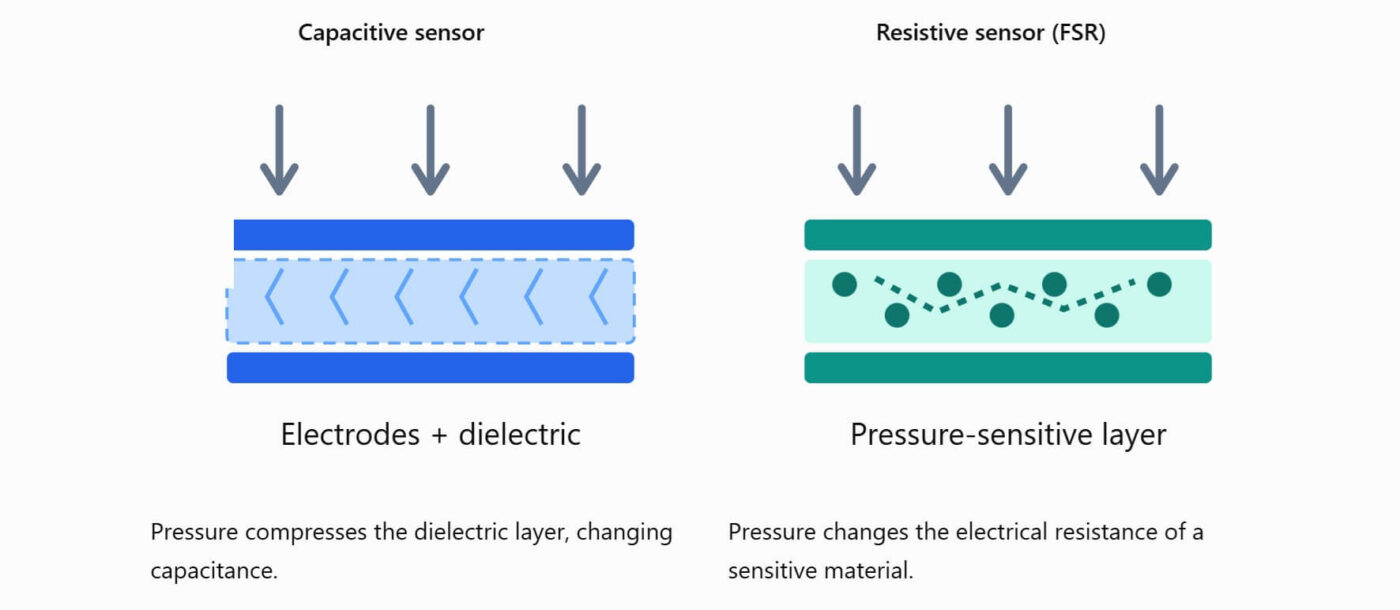
Capacitive sensors work by measuring a change in capacitance when pressure is applied. When force compresses the dielectric layer between two conductive plates, the distance between them changes, which changes the capacitance.
Basic principle:
C = ε₀ εᵣ A / d
Where C represents capacitance, A is the electrode overlap area, d is the distance between the electrodes, and ε₀εᵣ represents the dielectric permittivity.
As the applied pressure increases, the distance between the electrodes typically decreases, resulting in an increase in capacitance.
A carefully designed capacitive structure can provide a sensitive, repeatable electrical response, making it particularly useful for measuring changing pressures beneath the foot or wherever precision matters.
Resistive Sensors
Resistive sensors, often called force-sensitive resistors (FSRs), work by changing their electrical resistance when pressure is applied. The conductive material inside the sensor responds to force by reducing resistance.
While this method is simple and low-cost, the output can be more affected by material behavior, repeated loading, and time-dependent changes.
The Advantages of Capacitive Sensing
Why Measurement Stability Matters in Smart Insoles
Every step creates a complex sequence of loading and unloading beneath the foot. To measure these forces accurately, an insole must produce consistent sensor readings across thousands of repeated movements.
Capacitive sensors are especially attractive for this purpose because of several key performance advantages.
Higher Measurement Accuracy
Capacitive sensors can provide a predictable relationship between applied pressure and electrical output, particularly when their mechanical structure and electronics are carefully optimized.
This makes it possible to measure pressure variations with high precision and support accurate pressure analysis across different regions of the foot, hand and … .
Better Repeatability
During walking, the foot repeatedly applies and releases force.
A reliable sensor should produce nearly identical measurements whenever the same pressure is applied under comparable conditions.
Well-designed capacitive sensors often demonstrate better repeatability than conventional FSRs, reducing inconsistencies between successive steps.
Lower Hysteresis
Hysteresis occurs when a sensor produces different outputs at the same pressure depending on whether the applied force is increasing or decreasing.
In pressure measurement, high hysteresis can introduce errors during the loading and unloading phases of walking.
Capacitive sensors using suitable dielectric materials can achieve low hysteresis, supporting more consistent force measurements throughout the gait cycle.
Improved Long-Term Stability
Smart insoles must maintain dependable performance during repeated bending, compression, and everyday use.
Resistive sensing materials may experience changes in their electrical behavior over time, which can lead to signal drift and increased calibration requirements.
Properly engineered capacitive sensors can offer better long-term measurement stability, supporting consistent pressure monitoring over extended use.
pedar · In-shoe pressure measurement
Higher validity and reliability
In their 2023 comparative review, Burnie and colleagues identify pedar as the most valid and reliable in-shoe system for plantar-pressure measurement in the published research they assessed. The review also cites a direct comparison in which pedar showed better validity and reliability than two commercially available resistive systems.
This evidence supports pedar as a strong choice when dependable, repeatable plantar-pressure data are a priority. The review also notes that system selection should reflect the application, including connectivity and cost.
Burnie et al. (2023). Commercially available pressure sensors for sport and health applications: A comparative review. The Foot, 56, 102046.
Read the pedar reviewpliance · Interface pressure measurement
Lower error and less drift
A 2026 study by Thompson and colleagues compared pliance with Tekscan I-Scan and XSENSOR X3. During 30-minute static tests on flat and curved surfaces at 30–90 kPa, pliance recorded the lowest absolute error and drift rate, with statistically significant differences from both other systems.
For sustained interface-pressure measurements, these results support pliance as a strong choice where accuracy and signal stability matter.
Thompson et al. (2026). Under pressure: The effect of system, surface geometry, and load on the measure of contact pressure. International Journal of Industrial Ergonomics, 114, 103969.
Read the pliance studyThe pliance comparison at a glance
| System | Absolute error (kPa) |
Drift rate (kPa/min) |
|---|---|---|
| novel pliance | 4.51 ± 2.26 | 0.05 ± 0.06 |
| Tekscan I-Scan | 7.16 ± 4.70 | 0.15 ± 0.11 |
| XSENSOR X3 | 9.29 ± 4.90 | 0.08 ± 0.07 |
Values reported by Thompson et al. (2026); lower values indicate less error or drift. Findings apply to the tested systems and static interface-pressure conditions.
