
loadsol / Sports & rehabilitation

ACL rehabilitation & return-to-sport monitoring

See how an athlete loads each foot, from baseline testing to rehabilitation after an anterior cruciate ligament (ACL) injury. loadsol® force-sensing insoles bring objective loading data into the clinic, the training hall and the field.

Discuss your application Explore the research
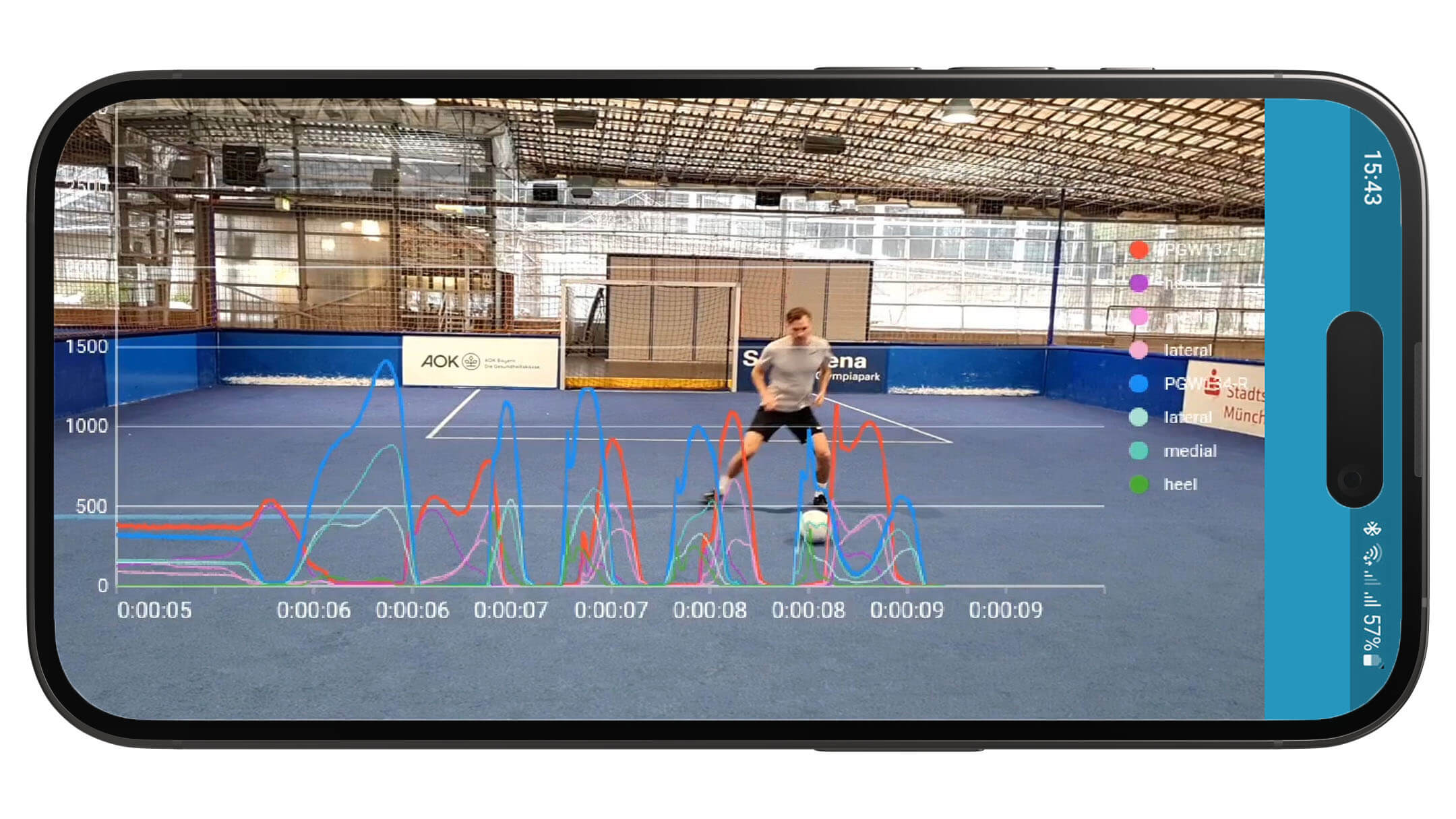
Recording football movement with loadapp video and synchronized in-shoe force curves

Movement on video. Force data alongside it.
01 / Published research

loadsol accuracy & reliability in scientific articles:

Any system used, should be validated and work reliably. Make sure that the validation considers the force measurement and not just derived and simplified parameters like “contact time”, etc. 

Study 01

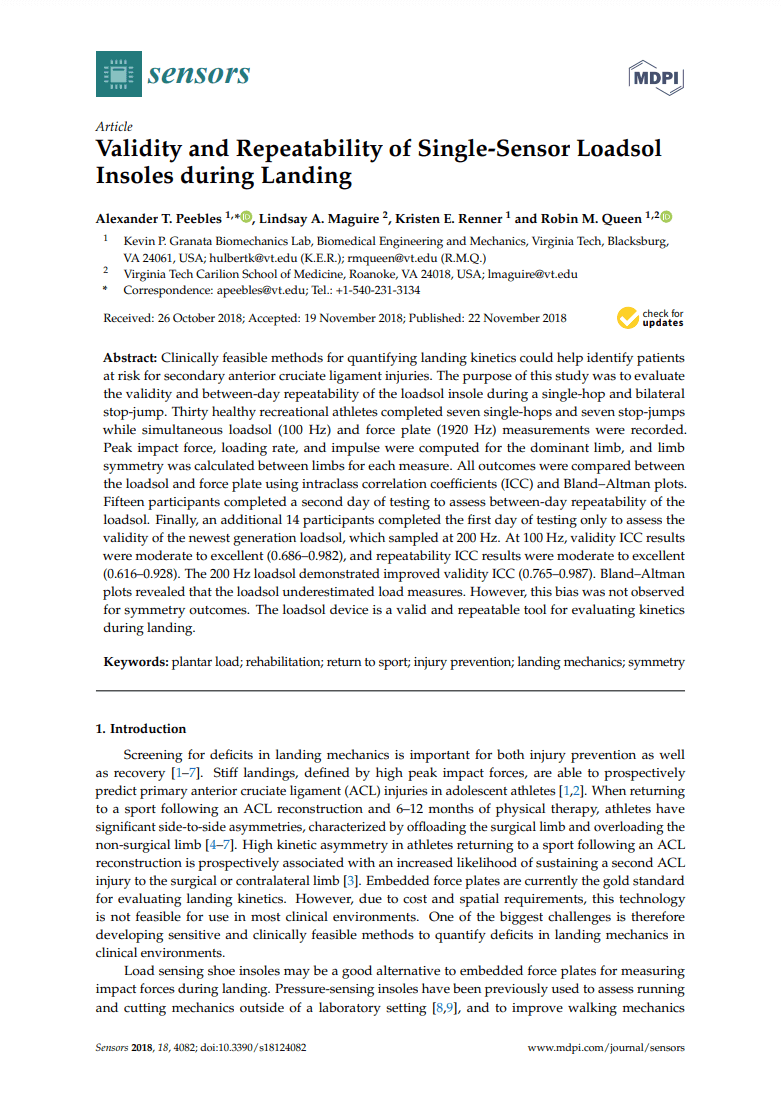
Publication: Validity and Repeatability of Single-Sensor Loadsol Insoles during Landing

“Validity and Repeatability of Single-Sensor Loadsol Insoles during Landing”

by Robin M. Queen, Alexander T. Peebles, Kristen E. Renner

Screening for deficits in landing mechanics is important for both injury prevention as well as recovery. Stiff landings, defined by high peak impact forces, can prospectively predict primary anterior cruciate ligament (ACL) injuries in adolescent athletes. When returning to sport following an ACL reconstruction and 6–12 months of physical therapy, athletes have significant side-to-side asymmetries, characterized by offloading the surgical limb and overloading the non-surgical limb. High kinetic asymmetry in athletes returning to sport following an ACL reconstruction is prospectively associated with an increased likelihood of sustaining a second ACL injury to the surgical or contralateral limb 

This study suggests that  loadsol is a valid and repeatable device to use in the assessment of ground-based kinetics and kinetic symmetry during hopping and jumping tasks.


Study 02

Publication: Using force sensing insoles to predict kinetic knee symmetry during a stop jump

“Using force sensing insoles to predict kinetic knee symmetry during a stop jump”

by  Alexander T. Peebles, Kevin R. Ford, Jeffrey B. Taylor, Joseph M. Hart, Laura P. Sands & Robin M. Queen

Athletes returning to sport following ACLR have a 30–35% chance of sustaining a second ACL injury to either the surgical or contralateral limb. Asymmetrical limb loading during bilateral landing tasks, where the surgical limb load is decreased and the non-surgical limb load is increased, is extremely common among ACLR patients and is believed to contribute to this heightened risk of reinjury. As asymmetrical limb loading during landing does not simply resolve with time during rehabilitation and following return to sport, it is imperative that limb loading symmetry be quantified and improved during post-operative physical therapy.

loadsol has been validated against embedded force plates for measuring peak impact force, loading rate, and impulse and for assessing load symmetry using these measures. The loadsol could therefore be useful for assessing limb loading symmetry in clinical settings.


Study 03

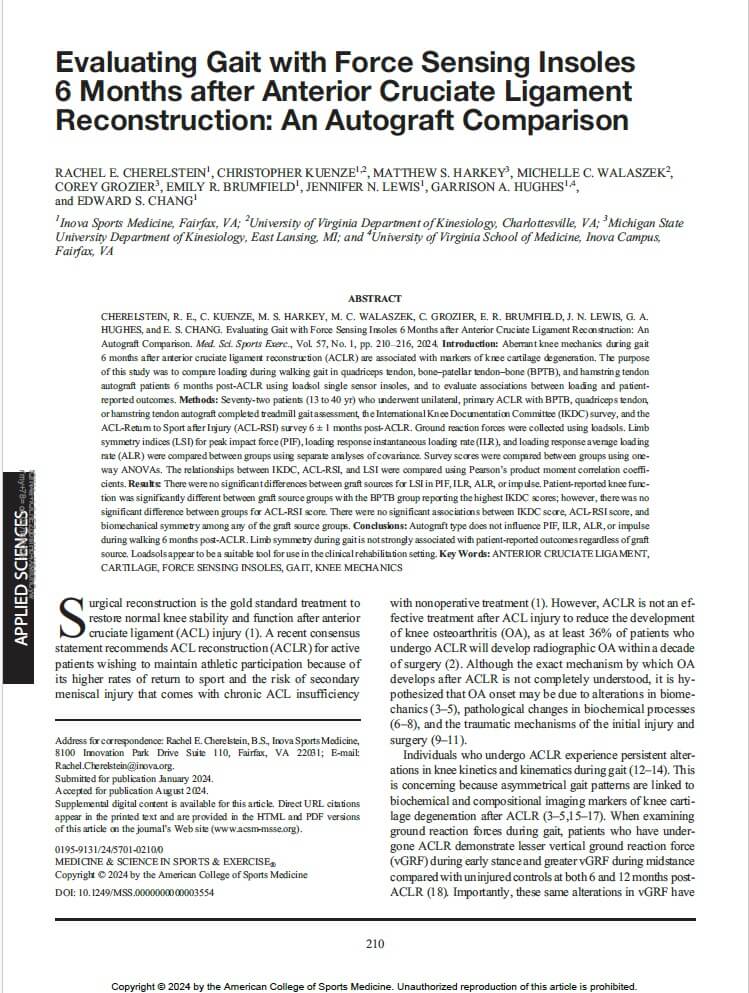
Publication: Evaluating Gait with Force Sensing Insoles 6 Months after Anterior Cruciate Ligament Reconstruction: An Autograft Comparison

“Evaluating Gait with Force Sensing Insoles 6 Months after Anterior Cruciate Ligament Reconstruction: An Autograft Comparison”

by CHERELSTEIN, RACHEL E.; KUENZE, CHRISTOPHER; HARKEY, MATTHEW S.; WALASZEK, MICHELLE C.; GROZIER, COREY; BRUMFIELD, EMILY R.; LEWIS, JENNIFER N.; HUGHES, GARRISON A.; CHANG, EDWARD S.

The study utilized loadsol single-sensor insoles to assess gait mechanics in patients six months after ACL reconstruction (ACLR). Participants walked on a treadmill at a self-selected pace while Loadsol measured key ground reaction force (GRF) metrics, including Peak Impact Force (PIF), Instantaneous Loading Rate (ILR), and Average Loading Rate (ALR). These insoles provided real-time data on limb loading asymmetry, which is critical in understanding biomechanical deficiencies post-ACLR. The researchers compared different autograft types (Bone-Patellar Tendon-Bone, Quadriceps Tendon, and Hamstring Tendon) to evaluate whether graft choice influenced gait mechanics. They found no significant differences in GRF or symmetry indices between graft groups, suggesting that autograft type does not substantially impact gait patterns at this stage of recovery.

The study concluded that loadsol is a practical and effective tool for clinical ACL rehabilitation. Its ease of use, affordability, and real-time feedback capabilities make it a valuable alternative to traditional laboratory-based force plates, which are costly and require specialized training. Although the study did not find a strong association between gait asymmetries and patient-reported outcomes, the authors emphasized that loadsol could still play a crucial role in tracking rehabilitation progress and identifying asymmetries that may contribute to long-term joint degeneration. By integrating loadsol into clinical practice, clinicians can objectively measure limb loading, adjust rehabilitation strategies accordingly, and potentially reduce the risk of post-ACLR osteoarthritis.

Study 04

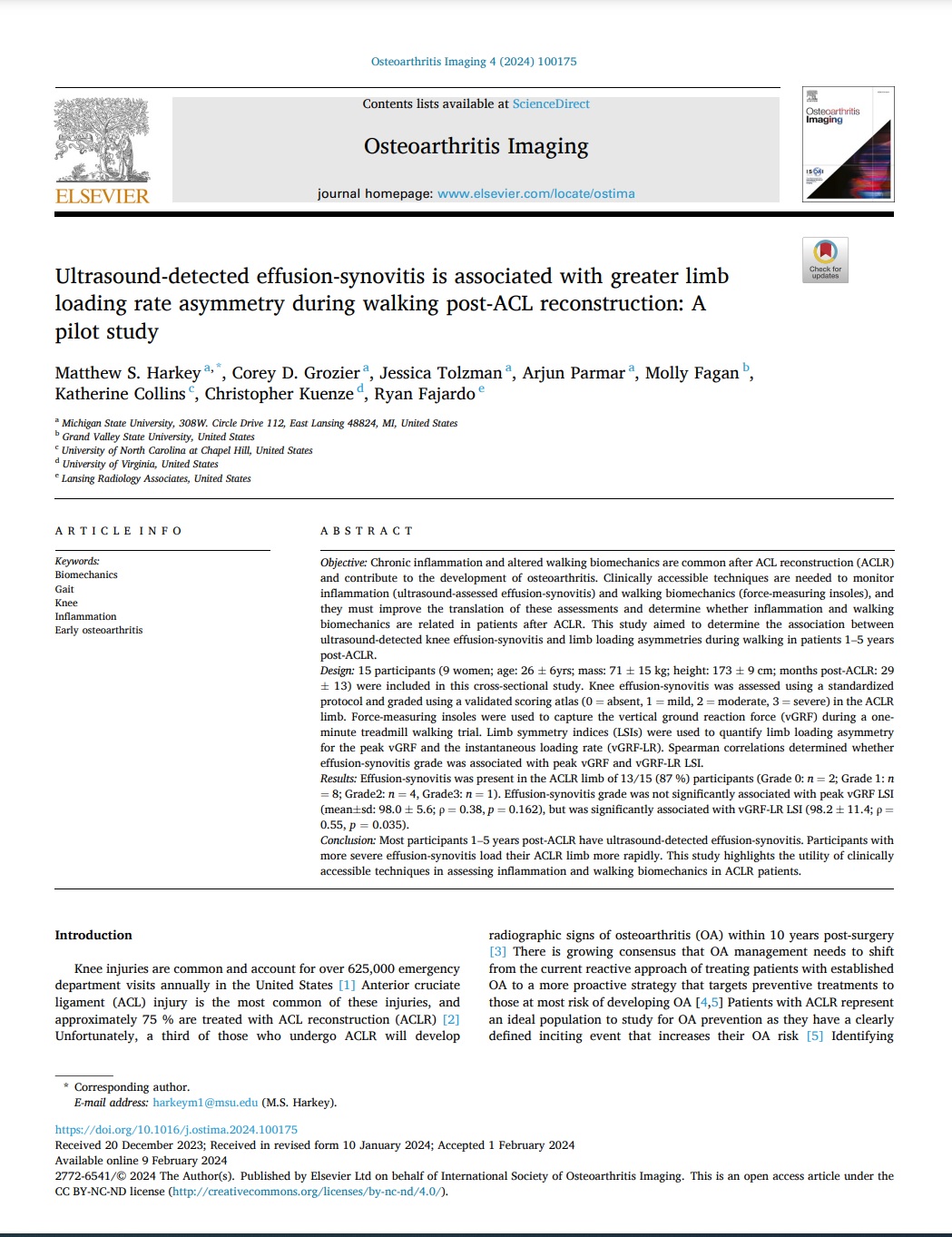
Publication: Ultrasound-detected effusion-synovitis and limb loading rate asymmetry during walking after ACL reconstruction

“Ultrasound-detected effusion-synovitis is associated with greater limb loading rate asymmetry during walking post-ACL reconstruction: A pilot study”

by Kristen E. Renner, DS Blaise Williams & Robin M. Queen

After ACL reconstructions (ACLR), many patients suffer from inflammations in their operated knee even years after the operation. ACLR patients also often show altered biomechanics in e.g. walking which can increase the risk for the development of musculoskeletal disorders like osteoarthritis in the long run. Inflammation and altered biomechanics seem to interact closely. In particular, increasing grades of effusion-synovitis (an imaging marker of inflammation) are associated with asymmetry in the loading rates of the healthy vs. operated leg during normal walking in patients 1-5 years post ACLR.

This study shows that loadsol can be used to assess differences in walking biomechanics that are correlated with markers of inflammation in ACLR patients. The loadsol could therefore be used to assess long-term knee inflammation in ACLR patients.

Study 05

Publication: The Reliability and Validity of the loadsol under Various Walking and Running Conditions

“The Reliability and Validity of the loadsol under Various Walking and Running Conditions”

by Kristen E. Renner, DS Blaise Williams & Robin M. Queen

The assessment of loading during walking and running has historically been limited to data collection in laboratory settings or with devices that require a computer connection. loadsol is a wireless insole and is a valid and reliable method of

assessing force

This study shows that  loadsol can be used to assess load based parameters during various walking and running tasks. This insole has the potential to be used in the assessment and tracking of various clinical populations recovering from injuries and surgeries. loadsol could also be used to assess changes in load parameters in the clinical setting to track recovery and restoration of symmetric loading following a variety of surgical and nonsurgical interventions. Moreover, it can also be used when asking subjects to maintain a partial weight bearing protocol following surgery through setting load thresholds within the mobile application that can alert the subjects when they are placing more load on the foot than recommended during recovery.

Putting force data in context. loadsol measures loading underfoot, rather than force within the ACL itself. The publications above cover different tasks and populations. Findings should be interpreted for the tested conditions; a single loading or symmetry measure cannot determine injury risk or readiness to return to sport.

Return-to-sport decisions involve a broader clinical assessment. See the Panther Symposium ACL return-to-sport consensus.

02 / Before injury and through recovery

Understand loading at each stage.

A jump distance or walking speed does not tell the whole story. In-shoe force measurement helps show how the two limbs contribute to a task, and how that contribution changes over time.

Before injury

Build an individual baseline

Record how an athlete loads each foot during selected tasks. Repeat the same test conditions over time to investigate changes in force production and left-to-right loading. Baseline data can inform training discussions; it is not an individual injury prediction.

During rehabilitation

Follow changes across sessions

Measure loading during walking and, when appropriate, hopping and jumping tasks selected by the clinical team. Compare force curves and limb symmetry across sessions to support rehabilitation monitoring.

Return-to-sport assessment

Add force data to the discussion

Review loading alongside strength, symptoms, movement quality and psychological readiness. A force measurement adds useful information to the clinical picture; it does not provide return-to-sport clearance on its own.

03 / Force measurement in context

See more than the final score.

loadsol measures the normal force between the foot and the shoe. Review force-time curves and task-specific measures to understand how an athlete loads, pushes off and lands.

Peak force
How high the force rises during a selected movement.
Loading rate
How quickly force increases during loading.
Impulse
The area under the force-time curve over the selected interval.
Limb symmetry
How the left and right sides compare for the chosen measure.

Use consistent footwear, task instructions and analysis settings when comparing sessions. Choose the sensor configuration and sampling rate to suit the movement being measured.

Explore the loadsol system
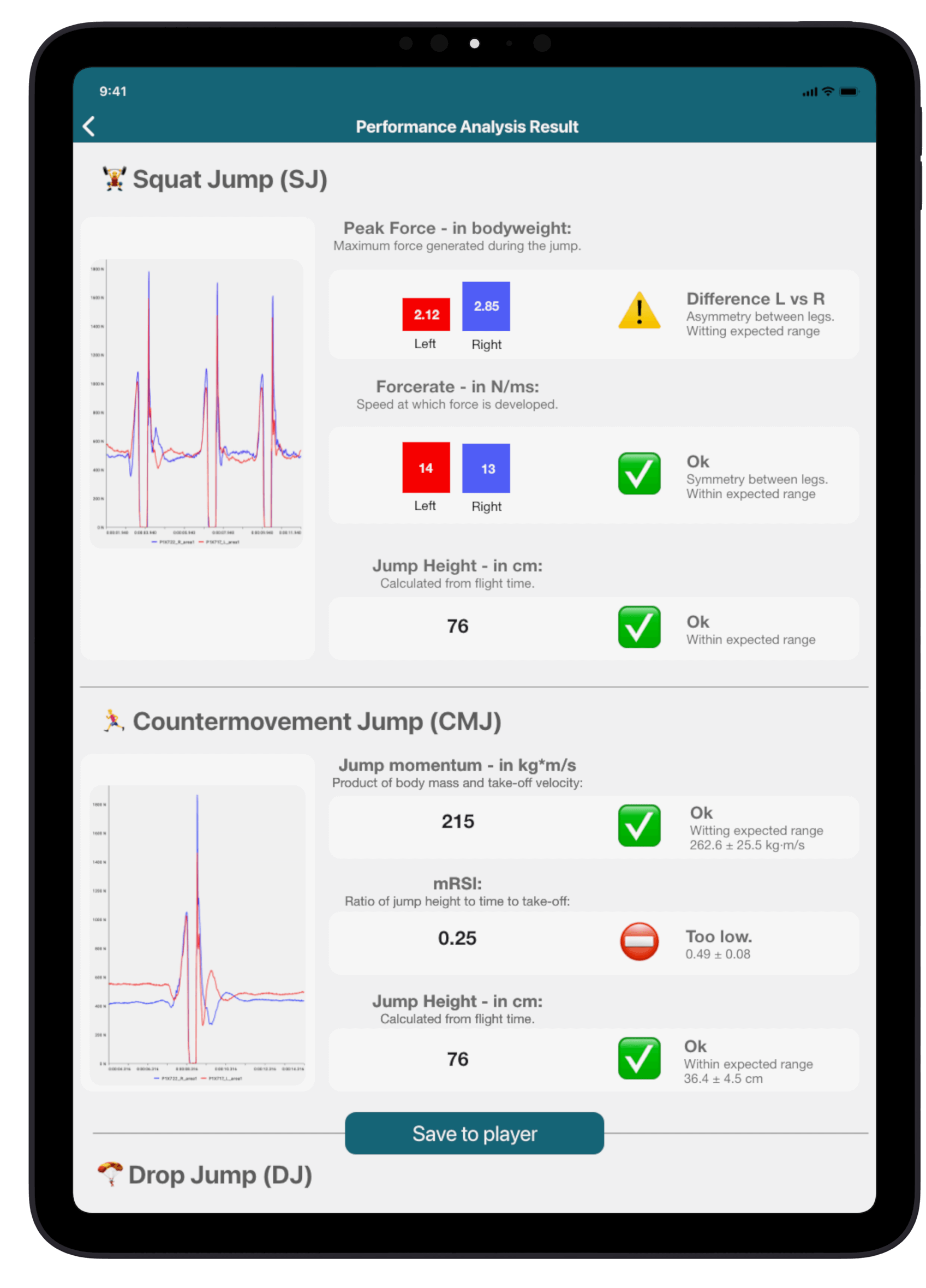
Example loadsol performance analysis dashboard with force curves and left-right comparisons

Example analysis dashboard. Click to view the full image.

loadapp screen showing football video with synchronized left and right foot force curves

Connect the force curve to the movement.

Record a measurement with loadapp and compare the video with the force data. This helps you locate take-off, landing and other events, then review the same moment with the athlete or clinical team.

View the full measurement image

04 / Measurement in practice

Watch a single-leg hop test.

See an example of loadsol in use during a single-leg hop test. The movement and force recording can be reviewed together as part of an assessment.

For rehabilitation testing, the clinical team selects tasks that are appropriate for the athlete’s stage of recovery.

Watch on YouTube

Practical questions

Using loadsol for ACL assessment.

Can loadsol be used before an ACL injury?

It can be used to record task-specific force and loading baselines in uninjured athletes. Follow-up tests can help identify changes worth discussing with the training or clinical team. These measurements do not predict whether an individual will sustain an ACL injury.

How can loadsol support ACL rehabilitation monitoring?

It provides force-time data from inside the shoe. Clinicians and researchers can compare loading between limbs and across sessions during suitable tasks, alongside other rehabilitation measures.

Does limb symmetry mean an athlete is ready for sport?

Symmetry is one part of an assessment. It should be considered alongside each limb’s performance, symptoms, strength, movement quality, sport demands and psychological readiness.

Can I review the images in more detail?

Yes. Click the measurement and dashboard images to open a larger view. Each publication cover and its details link take you to the original article.

Your next measurement

Build a measurement setup around your work.

Tell us about the movements you want to measure, the footwear and the setting. We can help you choose the loadsol configuration and analysis tools for your research, clinical or sports application.