
novel.de

  • Increase font size
  • Default font size
  • Decrease font size

pliance

pliance systems for the accurate measurement of load distribution and pressure distribution on hard or soft surfaces

Visit applications of pliance
and pliance software

pliance systems offer the state of the art technology for pressure distribution measurement between soft and curved surfaces. The systems consist of a flexible and elastic measuring mat, a multi-channel analyser, a calibration device and a software package for PC's.


As in all physical measuring systems the most important part is the sensor technology. pliance works with capacitive transducers in a matrix configuration. The elasticity of the sensor mats permits perfect comformability to 3-dimensional deformations.
The pressure transducing elements contain high-tech elastomers manufactured by novel. Restoring force, range of force, threshold, hysteresis, temperature effect, frequency response and other characteristics are determined during the manufacturing process. This makes it possible to adapt the sensor characteristic to different measuring needs. The elastic measuring mats are available in various sizes, sensor configurations and pressure ranges.


Technical data for pliance-x (-32) system 


  dimensions (mm)   150x100x40
  weight (g)   360
  number of sensors (max)   256(1024)
  measurement frequency   20,000 sensors /second
  storage type   32 MB internal flash
  computer interface   fiber optic/ USB and Bluetooth TM
  operating system   Windows
  sync option   fiber optic/ TTL, in and out
  power supply   NIMh battery


pliance FTX pliance FTM


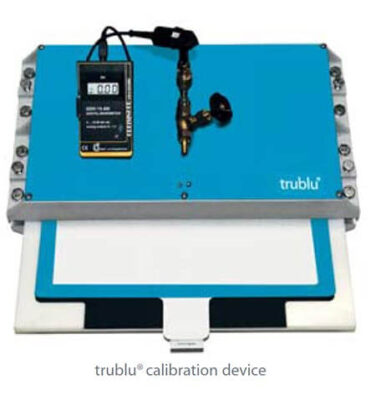
trublu calibration device


The pliance analysers vary from small portable 16x16 channel units to large 112x112 channel units with a wide range of options, such as master-slave synchronisation of several systems, dynamic amplification control, synchronisation of video systems and analog inputs for accelerometors.

novel developed an analyser technology that allows not only individual calibration curves for each sensor, but also individual dynamic amplification control and crosstalk suppression, resulting in very accurate and reproducible pressure values. The pliance analysis can work with PC's via the USB interface. Notebook computers or even pocket PC´s can be used for mobile tests.

The trublu calibration device can be used at any time to verify the quality of the measuring results. It works with homogeneous air pressure on all sensors through increasing steps of pressure. Thus an individual calibration curve for each sensor is calculated and used during data aquisition.

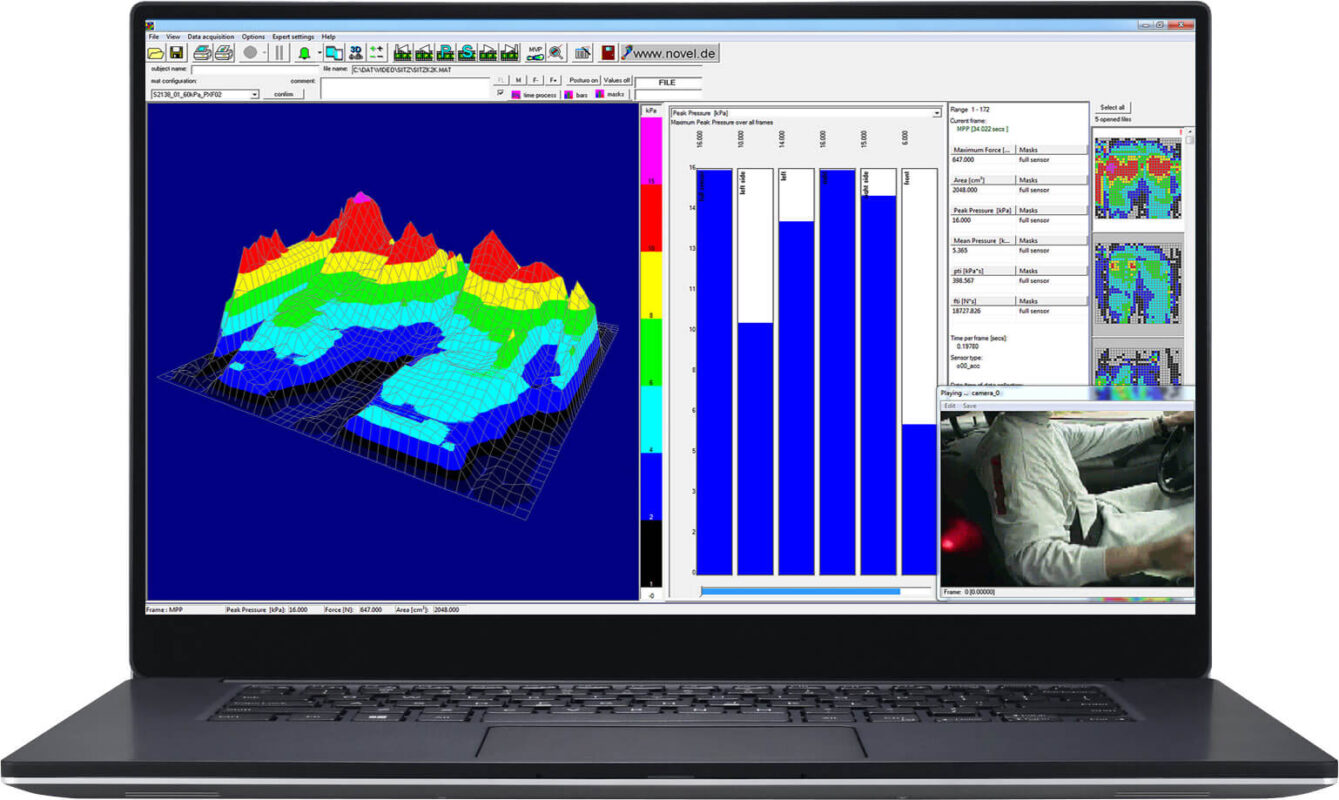
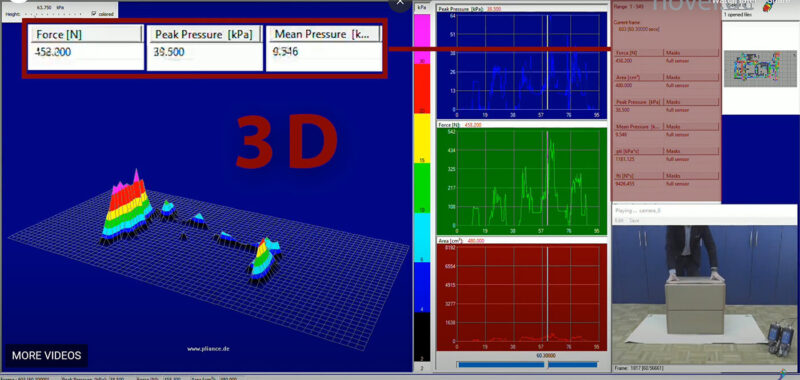
The software operates as a Windows application and contains many useful methods of data collection and scientific analysis of dynamic pressure distrubution. It also allows continuous data storage in online mode and data handling with a configurable SQL database. The expert can design the parameter configuration to specific needs and exchange data with collegues via HTML protocol.

bed matress

hand

Dynamic hand grip sensor analysis


pliance® hand sensors

The pliance® hand sensor family has been designed for:

  • accurate and functional diagnostics of hand pre- and post surgery
  • evaluation of rehabilitation progress
  • ergonomic assessment during occupational activities
  • biomechanic and orthopaedic research


novel systems are based on calibrated, accurate and reliable capacitive sensors. The individual sensor elements are elastic and arranged in a matrix, which conforms to 3-dimensional shapes. The sensor matrix is connected to the novel pliance® electronics hardware. The pressure analysis can be done on- or off-line by a PC or a handheld personal digital assistent (PDA).


pliance® cylinder sensors
The pliance® cylinder mats are specifically designed for measurement of pressure distribution and contact forces while gripping a cylinder. This measurement can be used for standardising functional diagnostics at different hand locations. A definitive comparison of hand function pre- and post surgery is possible and the progress during rehabilitation can be objectively evaluated.
The mats are available in various sizes so the user can select different cylinder diameters to accommodate hand size or other testing requirements.


Technical data for elastisens HA87

  number of sensors   256
  total sensor area (mm2)   140 x 140
  size of one sensor element (mm2)   8.75 x 8.75
  thickness (without coating) (mm)   < 1.2
  pressure range (kPa)   3-200


Technical data for elastisens HA78

  number of sensors   256
  total sensor area (mm2)   125 x 125
  size of one sensor element (mm2) 7.8 x 7.8
  thickness (without coating) (mm) < 1.2
  pressure range (kPa)   3-200

Technical data for elastisens HA44

  number of sensors   256
  total sensor area (mm2)   70.4 x 70.4
  size of one sensor element (mm2) 4.4 x 4.4
  thickness (without coating) (mm)   < 1.2
  pressure range (kPa)   5-200


pliance® glove sensor
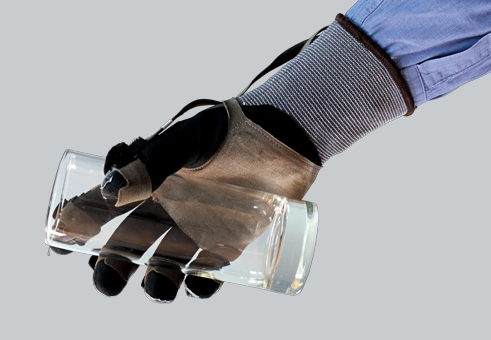
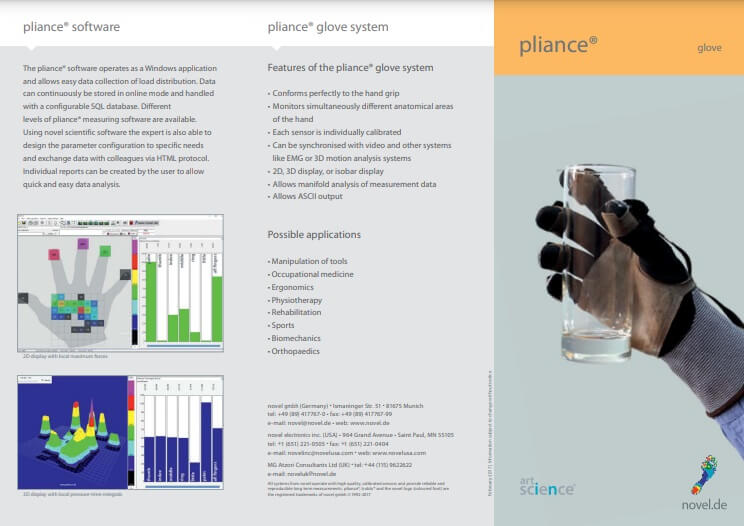
The pliance® glove sensors are primarily designed for measurement of pressure distribution at a hand-machine interface. The unique design of the sensors conforms to the shape of the hand allowing various handgrips to be tested in different situations
(e.g. jackhammers, road drills, chainsaws, etc.)

Technical data for glove sensor

  number of sensors 125
  total sensor area (mm2)   12,896
  size of one sensor element (mm2)   6 x 16
  thickness (without coating) (mm) < 1


pliance® strip sensor
The pliance® strip sensor may be required for special pressure
distribution applications with limited hand area, for example on one
finger. The strip sensor consists of 10 sensors arranged in a single row.

Technical data for strip sensor


  number of sensors   10
  total sensor area (mm2)   100 x 10
  size of one sensor element (mm2)   10 x 10
  thickness (without coating) (mm)   0.1 - 0.6
  pressure range (kPa)   2-100 / 10-1000


pliance® hand mat sensor
The pliance® hand mat sensor is a high spatial resolution
matrix which allows a detailed investigation of specific hand and finger regions. This pressure measurement can be used for example to follow the recovery during physiotherapy of an injured hand
or to evaluate the possible progression of diseases affecting the hand.

Technical data for elastisens HA50/1024

  number of sensors   1024
  total sensor area (mm2)   160 x 160
  size of one sensor element (mm2)   5 x 5
  thickness (without coating) (mm)   < 1.2
  pressure range (kPa)   5-60


pliance®-x analyser
The pliance® -x electronic analyser connects up to 1024 sensors to a desktop, notebook PC or handheld PDA. The software is written for Windows operating systems and allows a wide range of scientific analysis. Collected data can be stored on the flash memory
or transmitted online to a PC or Pocket PC (PDA) via the built-in telemetry.

Technical data for pliance®-x

  dimensions (mm)   150x100x40
  weight (g)   360
  number of sensors (max)   256 (1024)
  measurement frequency   20,000 sensors/second
  storage type   32MB internal flash
  operating system   Windows XP, Service Pack2
  power supply   NiMH battery, 4.5 hours
  computer interface   fiber optic/USB and  BluetoothTM
  sync option   fiber optic/TTL, in and out/wireless
  telemetry   BluetoothTM
  recording time   25 min at 100 Hz to flash  memory

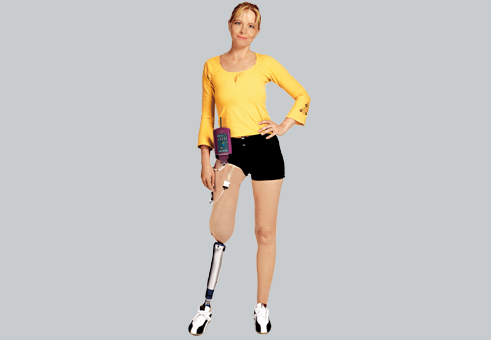
prothesis

The pliance-RLS prosthesis system has been developed for socket evaluation and fit. It provides a quantification of the level of pressure at the residual limb/socket interface during static and dynamic movements.

As a result of their design and material selection, the pliance-RLS sensors are flexible and elastic and have the ability to conform very well around highly contoured sites. This is particularly advantageous in prosthetics because of the highly irregular surface and geometry of the residual limb and the shape of the socket.

The pliance-RLS sensors include a dense array of sensors, with a small individual sensor area. This allows recording of interface pressure at a discrete location of the socket. The length of the sensor pad is appropriate for use on a short or long transtibial socket.The different standard shapes allow testing of different
anatomical areas simultaneously. Custom made sensors are also available.


       susifokus.jpg

Pliance-RLS system

Pliance-videos:

transfemoral socket stair walking
 

transfemoral socket walking


saddle

pliance®-s test system

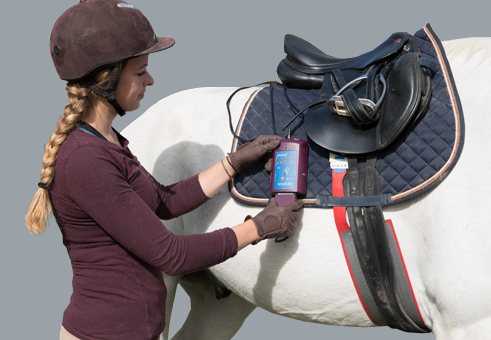
The pliance®-s system marks the beginning of a new era in the assessment of the dynamic inter-action between the horse, the saddle and the rider.

How does the rider sit?
How does the saddle fit?
What does the horse feel?

pliance®-s measures the dynamic pressure distribution between the saddle and the horse using a thin elastic sensor mat.

It is possible to assess quantitatively the commands of the rider and the subsequent reaction of the horse. The technique of the rider can be objectively assessed and corrected. Data can be immediately viewed with easy to use software.


horsesoftware2.jpg

Using pliance® recorder software, the dynamic pressure distribution can be directly compared to synchronized video pictures.

Harmful pressure points that arise from poor saddle fit can be recognized and corrected. During dynamic movement, such as trotting and gallopping, substantially higher loads occur on the back and the shoulders of the horse as compared to standing. The pressure distribution under the saddle during dynamic movement of the horse can be measured in order to assess the fit.

The pliance®-s sensor mat contains 2 x 128 sensors which are scanned with a scanning speed of 20,000 sensors per second. Dynamic measurements can be recorded for all paces, from the walk to the gallop.

Gait asymmetry of the horse, possibly associated with physiological back problems or poor saddle fit, can be assessed quantitatively. The pliance®-s system is accurate and reliable. The sensor mat is calibrated in a simple, computer- aided procedure which calculates the calibration curves for each individual sensor. The calibration remains stable with time.

The pliance®-s software operates as a Windows application and displays dynamic pressure distribution on screen as a 2D or 3D color picture. The pictures can be printed in their original size to allow the user to relate the pressures precisely to the horse’s anatomical landmarks or to the saddle.
All data are fully compatible with novel scientific software packages and can also be exported in ASCII format.

With the help of the pliance®-s system and its powerful software one can analyse the quality of the saddle and obtain a better understanding of the interaction between the rider, the saddle and the horse.


pliance® -s system

pliance® -s system in use

application of pliance® -s sensor mat

fixation of pliance® -s sensor mat

completion of pliance® -s sensor mat

pliance® -s data acquisition unit

Pliance horse mat

 
Features of pliance®-s system

  • can measure English and Western saddles
  • adapts perfectly to horseback and saddle shape
  • measures in static and dynamic mode
  • stores data on a flash memory up to 30 min without computer
  • collects accurate, calibrated values
  • scans 60 frames per second
  • records video synchronized
  • includes telemetry
  • works with Windows


Technical data of pliance®-s system

  • number of sensors 2 x 128
  • sensor mat thickness (mm) 2.6
  • measurement range (kPa) 1 - 60
  • measurement frequency (Hz) 60
  • dimensions of pliance box (mm) 150 x 100 x 40
  • weight (g) 360
  • storage type 32 MB internal flash
  • recording time to internal flash (min) 30
  • operating system Windows
  • power supply NiMH battery, 4.5 hours
  • computer interface fiber optic/USB and BluetoothTM

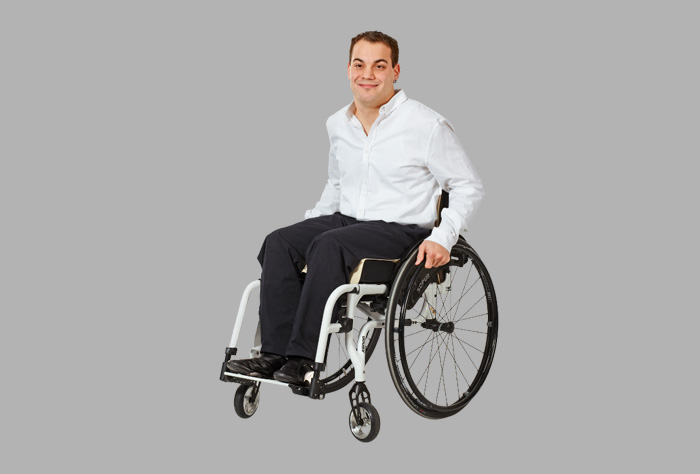
wheelchair

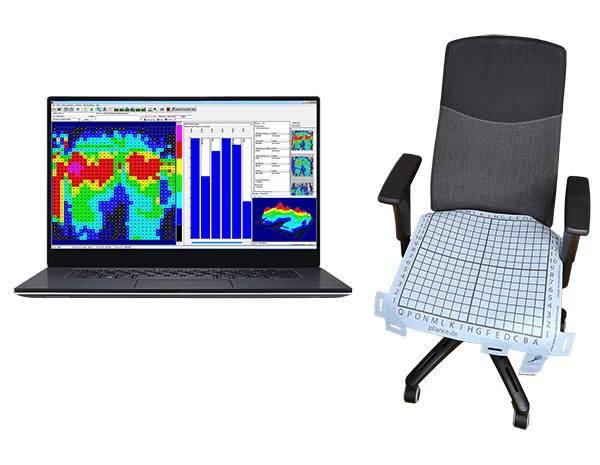
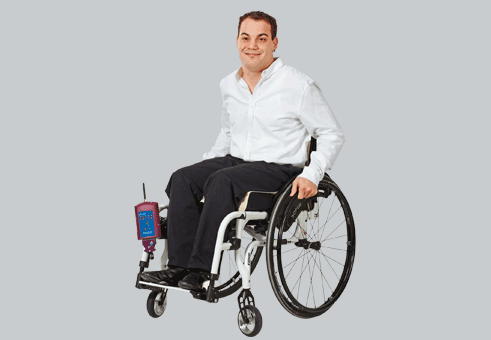
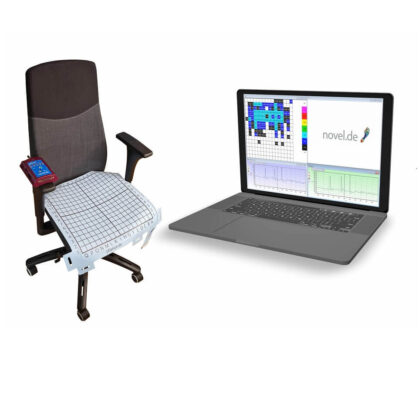
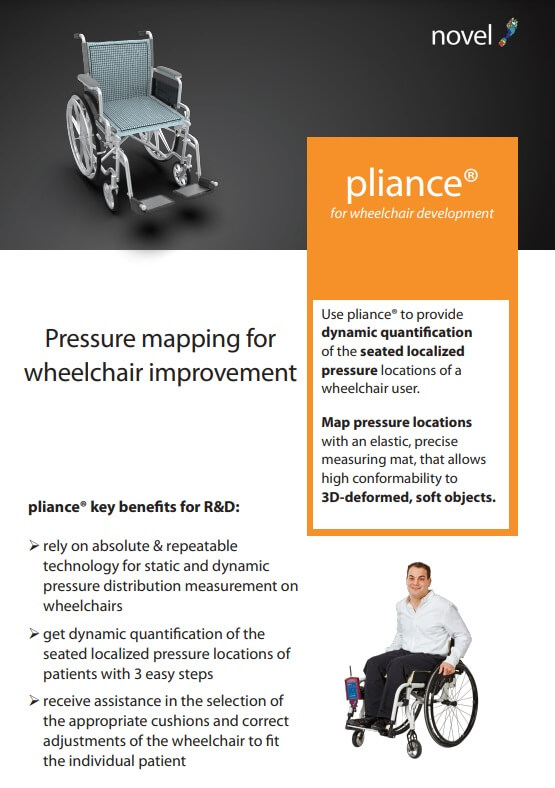
The pliance-HS wheelchair systems offer the state of the art technology for static and dynamic pressure distribution measurement on wheelchairs.

The new pliance-HS wheelchair system provides a dynamic quantification of the sitting pressure points of patients in wheelchairs.

This system helps in selecting the appropriate cushions and correct adjustments of the wheelchair to fit the individual patient. For real-life testing, all measurements can be done dynamically while the wheelchair is moving. The pliance functions with Bluetooth® wireless telemetry systems in a wide measurement range. The telemetry allows the user to watch the patient in the wheelchair and at the same time fully control the testing from a PC.


pliance wheelchair sensor mat
The system consists of a not only flexible but also elastic measuring mat, a multi-channel analyser, a calibration device and a software package for Windows XP computers. As in all medical measuring systems the most important part is the sensor technology. pliance works with accurate capacitive transducers in a matrix configuration. The elasticity of the sensor mats permits perfect conformability to 3-dimensional deformations. The pressure transducing elements contain high-tech materials manufactured by novel. Restoring force, range of force, threshold, hysteresis, temperature effect, frequency response and other characteristics are tailored to optimal use on wheelchairs.


trublu calibration device
With the aid of the trublu calibration device, all pliance-HS sensors
are individually and simultaneously calibrated with homogeneous air pressure. Calibration guarantees accurate and reproducible data collection.


pliance-x electronic analyser
connects up to 1024 sensors to a desktop, notebook PC or handheld Pocket PC. The software is written for Windows operating systems and allows a wide range of scientific analysis. Collected data can be stored on the internal flash memory or transmitted online to a PC or Pocket PC via the built-in Bluetooth® telemetry.


pliance wheelchair software
The pliance software operates as a Windows application and allows easy data collection. It contains many useful methods of data collection and analysis of dynamic pressure distribution. It also allows continuous data storage in online mode and data handling with a configurable SQL database. Using novel medical scientific software the expert can design the parameter configuration to his specific needs and exchange HTML data with collegues via Internet.


Features of pliance wheelchair sensor mat:

  • elastic
  • highly compliant
  • accurate
  • reproducible
  • low hysteresis
  • thin
  • calibrated
  • low temperature effect
  • water protection (optional)


Features of pliance wheelchair analyser:

  • accurate
  • dynamic
  • light-weight
  • easy to use
  • mobile
  • safe
  • synchronisable


Features of pliance wheelchair software:

  • easy to use
  • Windows XP compatible
  • multilingual
  • integrated with novel database
  • presents pressure-time integrals
  • allows multi-field analysis


hand

Dynamic hand grip sensor analysis

pliance - Manugraphy system - subscription offer 201
For further information, please contact
This email address is being protected from spambots. You need JavaScript enabled to view it. .
Download >>


pliance® hand sensors

The pliance® hand sensor family has been designed for:

  • accurate and functional diagnostics of hand pre- and post surgery
  • evaluation of rehabilitation progress
  • ergonomic assessment during occupational activities
  • biomechanic and orthopaedic research


novel systems are based on calibrated, accurate and reliable capacitive sensors. The individual sensor elements are elastic and arranged in a matrix, which conforms to 3-dimensional shapes. The sensor matrix is connected to the novel pliance® electronics hardware. The pressure analysis can be done on- or off-line by a PC or a handheld personal digital assistent (PDA).


pliance® cylinder sensors
The pliance® cylinder mats are specifically designed for measurement of pressure distribution and contact forces while gripping a cylinder. This measurement can be used for standardising functional diagnostics at different hand locations. A definitive comparison of hand function pre- and post surgery is possible and the progress during rehabilitation can be objectively evaluated.
The mats are available in various sizes so the user can select different cylinder diameters to accommodate hand size or other testing requirements.


Technical data for elastisens HA87

  number of sensors   256
  total sensor area (mm2)   140 x 140
  size of one sensor element (mm2)   8.75 x 8.75
  thickness (without coating) (mm)   < 1.2
  pressure range (kPa)   3-200


Technical data for elastisens HA78

  number of sensors   256
  total sensor area (mm2)   125 x 125
  size of one sensor element (mm2) 7.8 x 7.8
  thickness (without coating) (mm) < 1.2
  pressure range (kPa)   3-200

Technical data for elastisens HA44

  number of sensors   256
  total sensor area (mm2)   70.4 x 70.4
  size of one sensor element (mm2) 4.4 x 4.4
  thickness (without coating) (mm)   < 1.2
  pressure range (kPa)   5-200


pliance® glove sensor
The pliance® glove sensors are primarily designed for measurement of pressure distribution at a hand-machine interface. The unique design of the sensors conforms to the shape of the hand allowing various handgrips to be tested in different situations
(e.g. jackhammers, road drills, chainsaws, etc.)

Technical data for glove sensor

  number of sensors 125
  total sensor area (mm2)   12,896
  size of one sensor element (mm2)   6 x 16
  thickness (without coating) (mm) < 1


pliance® strip sensor
The pliance® strip sensor may be required for special pressure
distribution applications with limited hand area, for example on one
finger. The strip sensor consists of 10 sensors arranged in a single row.

Technical data for strip sensor


  number of sensors   10
  total sensor area (mm2)   100 x 10
  size of one sensor element (mm2)   10 x 10
  thickness (without coating) (mm)   0.1 - 0.6
  pressure range (kPa)   2-100 / 10-1000


pliance® hand mat sensor
The pliance® hand mat sensor is a high spatial resolution
matrix which allows a detailed investigation of specific hand and finger regions. This pressure measurement can be used for example to follow the recovery during physiotherapy of an injured hand
or to evaluate the possible progression of diseases affecting the hand.

Technical data for elastisens HA50/1024

  number of sensors   1024
  total sensor area (mm2)   160 x 160
  size of one sensor element (mm2)   5 x 5
  thickness (without coating) (mm)   < 1.2
  pressure range (kPa)   5-60


pliance®-x analyser
The pliance® -x electronic analyser connects up to 1024 sensors to a desktop, notebook PC or handheld PDA. The software is written for Windows operating systems and allows a wide range of scientific analysis. Collected data can be stored on the flash memory
or transmitted online to a PC or Pocket PC (PDA) via the built-in telemetry.

Technical data for pliance®-x

  dimensions (mm)   150x100x40
  weight (g)   360
  number of sensors (max)   256 (1024)
  measurement frequency   20,000 sensors/second
  storage type   32MB internal flash
  operating system   Windows XP, Service Pack2
  power supply   NiMH battery, 4.5 hours
  computer interface   fiber optic/USB and  BluetoothTM
  sync option   fiber optic/TTL, in and out/wireless
  telemetry   BluetoothTM
  recording time   25 min at 100 Hz to flash  memory


prothesis

The pliance-RLS prosthesis system has been developed for socket evaluation and fit. It provides a quantification of the level of pressure at the residual limb/socket interface during static and dynamic movements.

As a result of their design and material selection, the pliance-RLS sensors are flexible and elastic and have the ability to conform very well around highly contoured sites. This is particularly advantageous in prosthetics because of the highly irregular surface and geometry of the residual limb and the shape of the socket.

The pliance-RLS sensors include a dense array of sensors, with a small individual sensor area. This allows recording of interface pressure at a discrete location of the socket. The length of the sensor pad is appropriate for use on a short or long transtibial socket.The different standard shapes allow testing of different
anatomical areas simultaneously. Custom made sensors are also available.


       susifokus.jpg

Pliance-RLS system


Pliance-RLS system


conformability of RLS sensors to the socket shape

RLS sensors: different standard shapes


Pliance-videos:

transfemoral socket stair walking
 

transfemoral socket walking

saddle

pliance®-s test system

The pliance®-s system marks the beginning of a new era in the assessment of the dynamic inter-action between the horse, the saddle and the rider.

How does the rider sit?
How does the saddle fit?
What does the horse feel?

pliance®-s measures the dynamic pressure distribution between the saddle and the horse using a thin elastic sensor mat.

It is possible to assess quantitatively the commands of the rider and the subsequent reaction of the horse. The technique of the rider can be objectively assessed and corrected. Data can be immediately viewed with easy to use software.


horsesoftware2.jpg

Using pliance® recorder software, the dynamic pressure distribution can be directly compared to synchronized video pictures.

Harmful pressure points that arise from poor saddle fit can be recognized and corrected. During dynamic movement, such as trotting and gallopping, substantially higher loads occur on the back and the shoulders of the horse as compared to standing. The pressure distribution under the saddle during dynamic movement of the horse can be measured in order to assess the fit.

The pliance®-s sensor mat contains 2 x 128 sensors which are scanned with a scanning speed of 20,000 sensors per second. Dynamic measurements can be recorded for all paces, from the walk to the gallop.

Gait asymmetry of the horse, possibly associated with physiological back problems or poor saddle fit, can be assessed quantitatively. The pliance®-s system is accurate and reliable. The sensor mat is calibrated in a simple, computer- aided procedure which calculates the calibration curves for each individual sensor. The calibration remains stable with time.

The pliance®-s software operates as a Windows application and displays dynamic pressure distribution on screen as a 2D or 3D color picture. The pictures can be printed in their original size to allow the user to relate the pressures precisely to the horse’s anatomical landmarks or to the saddle.
All data are fully compatible with novel scientific software packages and can also be exported in ASCII format.

With the help of the pliance®-s system and its powerful software one can analyse the quality of the saddle and obtain a better understanding of the interaction between the rider, the saddle and the horse.


pliance® -s system

pliance® -s system in use

application of pliance® -s sensor mat

fixation of pliance® -s sensor mat

completion of pliance® -s sensor mat

pliance® -s data acquisition unit

Pliance horse mat


Features of pliance®-s system

  • can measure English and Western saddles
  • adapts perfectly to horseback and saddle shape
  • measures in static and dynamic mode
  • stores data on a flash memory up to 30 min without computer
  • collects accurate, calibrated values
  • scans 60 frames per second
  • records video synchronized
  • includes telemetry
  • works with Windows


Technical data of pliance®-s system

  • number of sensors 2 x 128
  • sensor mat thickness (mm) 2.6
  • measurement range (kPa) 1 - 60
  • measurement frequency (Hz) 60
  • dimensions of pliance box (mm) 150 x 100 x 40
  • weight (g) 360
  • storage type 32 MB internal flash
  • recording time to internal flash (min) 30
  • operating system Windows
  • power supply NiMH battery, 4.5 hours
  • computer interface fiber optic/USB and BluetoothTM

wheelchair

The pliance-HS wheelchair systems offer the state of the art technology for static and dynamic pressure distribution measurement on wheelchairs.

The new pliance-HS wheelchair system provides a dynamic quantification of the sitting pressure points of patients in wheelchairs.

This system helps in selecting the appropriate cushions and correct adjustments of the wheelchair to fit the individual patient. For real-life testing, all measurements can be done dynamically while the wheelchair is moving. The pliance functions with Bluetooth® wireless telemetry systems in a wide measurement range. The telemetry allows the user to watch the patient in the wheelchair and at the same time fully control the testing from a PC.


pliance wheelchair sensor mat
The system consists of a not only flexible but also elastic measuring mat, a multi-channel analyser, a calibration device and a software package for Windows XP computers. As in all medical measuring systems the most important part is the sensor technology. pliance works with accurate capacitive transducers in a matrix configuration. The elasticity of the sensor mats permits perfect conformability to 3-dimensional deformations. The pressure transducing elements contain high-tech materials manufactured by novel. Restoring force, range of force, threshold, hysteresis, temperature effect, frequency response and other characteristics are tailored to optimal use on wheelchairs.


trublu calibration device
With the aid of the trublu calibration device, all pliance-HS sensors
are individually and simultaneously calibrated with homogeneous air pressure. Calibration guarantees accurate and reproducible data collection.


pliance-x electronic analyser
connects up to 1024 sensors to a desktop, notebook PC or handheld Pocket PC. The software is written for Windows operating systems and allows a wide range of scientific analysis. Collected data can be stored on the internal flash memory or transmitted online to a PC or Pocket PC via the built-in Bluetooth® telemetry.


pliance wheelchair software
The pliance software operates as a Windows application and allows easy data collection. It contains many useful methods of data collection and analysis of dynamic pressure distribution. It also allows continuous data storage in online mode and data handling with a configurable SQL database. Using novel medical scientific software the expert can design the parameter configuration to his specific needs and exchange HTML data with collegues via Internet.


Features of pliance wheelchair sensor mat:

  • elastic
  • highly compliant
  • accurate
  • reproducible
  • low hysteresis
  • thin
  • calibrated
  • low temperature effect
  • water protection (optional)


Features of pliance wheelchair analyser:

  • accurate
  • dynamic
  • light-weight
  • easy to use
  • mobile
  • safe
  • synchronisable


Features of pliance wheelchair software:

  • easy to use
  • Windows XP compatible
  • multilingual
  • integrated with novel database
  • presents pressure-time integrals
  • allows multi-field analysis

tire

The pliance-ttx system was developed to measure pressure distribution at the contact area of a tire. Due to the design of the platform passenger vehicle tires as well as larger truck tires can be tested.

The capacitive sensor technology by novel is the most accurate and reliable measurement tool for this application since all the sensors are individually calibrated and stable over the long-term.
The pliance-ttx system includes software and system support as well as tailored measurement specifications.


pliance-ttx recorder software

  • automatic or manual start of data acquisition
  • dynamic measurement with selectable scanning rate
  • display of absolute pressure value for each sensor
  • synchronisation of pressure distribution measurement with video recording is possible
  • comparison display for different measurements pliance-ttx cross sections software
  • longitudinal and transversal cross sections are displayed
  • integrals are calculated
  • display of force and area for sensors loaded above a selectable pressure threshold
  • This scientific software for user defined pressure distribution analysis includes


novel database pro i 4

SQL database, designed according to the users needs, contains e.g. tire types, loading conditions, pressure distributions and additional files like drawings and HTML files.
It connects to all novel software packages for scientific data analysis.


novel multimask

Parameter analysis in selected areas
peak pressure, average pressure
force and force-time-integrals
center of pressure, contact area


Features of pliance-ttx

  • calibrated
  • durable
  • approved for industrial use
  • USB connected
  • Windows XP based
  • user friendly
  • ASCII output
  • HTML report system

knee

novel developed several prototype sensor systems for measuring the lateral/medial force balance between the tibia and the femur and the pressure distribution between the patella and the femur especially in artificial knee-joints.The sensor pads can be sterilzed in plasma sterilizers and can be used disposable or recyclable. They can be custom-made to fit individual artificial joints from different brands.

Because the pliance system is battery driven and wireless there is no risk for the patient within easy view of the surgeon. A Bluetooth Pocket PC can be used to display the data close to the surgeon's eyes.

Bargraphs show the surgeon the balance between medial and lateral load on the condyles and also the medial-posterior, medial-anterior and the lateral-posterior, lateral-anterior forces in flexion and extension.


kneepad sensor


AFK sensors

The novel AFK sensor(artificial knee sensors) was developed to measure interoperative balance of the ligaments. The shape of the sensor can be adapted to the structure of the knee joint product.

brassiere


Custom designed novel pliance-sensor pressure strips were introduced!

As the female breast contains limited anatomical support, external support, usually in the form of a brassiere, is worn to descrease excessive breast motion and associated breast pain.

As the causes of breast pain and the consequences of excessive breast motion are not known, brassiere designers need to address
structural issues within sports brassiere design that deter active females from wearing them.

bicycle combined in shoe and seat mat analysis


Bicycle testing, pedals and saddles

boxing

Novel sensors were used by Deutsche Sporthochschule Koeln to measure the impact on a dummy´s face. The test as in the photos on your left was broadcasted in a TV feature on the Olympic Games 2004.

grip

Pliance hand sensor systems

  • functional diagnostic of hands pre-and post surgery
  • evaluation of rehabilitation progress
  • ergonomic assessment during occupational activities
  • basic biomechanic and orthopaedic research
     

The general pliance data acquisition software operates in a Windows environment and contains many useful methods of data collection and scientific analysis of dynamic pressure. Features include: calibrated pressure values for each individual sensor element; Center of Pressure; 2D, 3D and isobar displays; force, pressure and area-time graphs.

Our robust analysis software can be used for data organization and detailed analysis

car seat


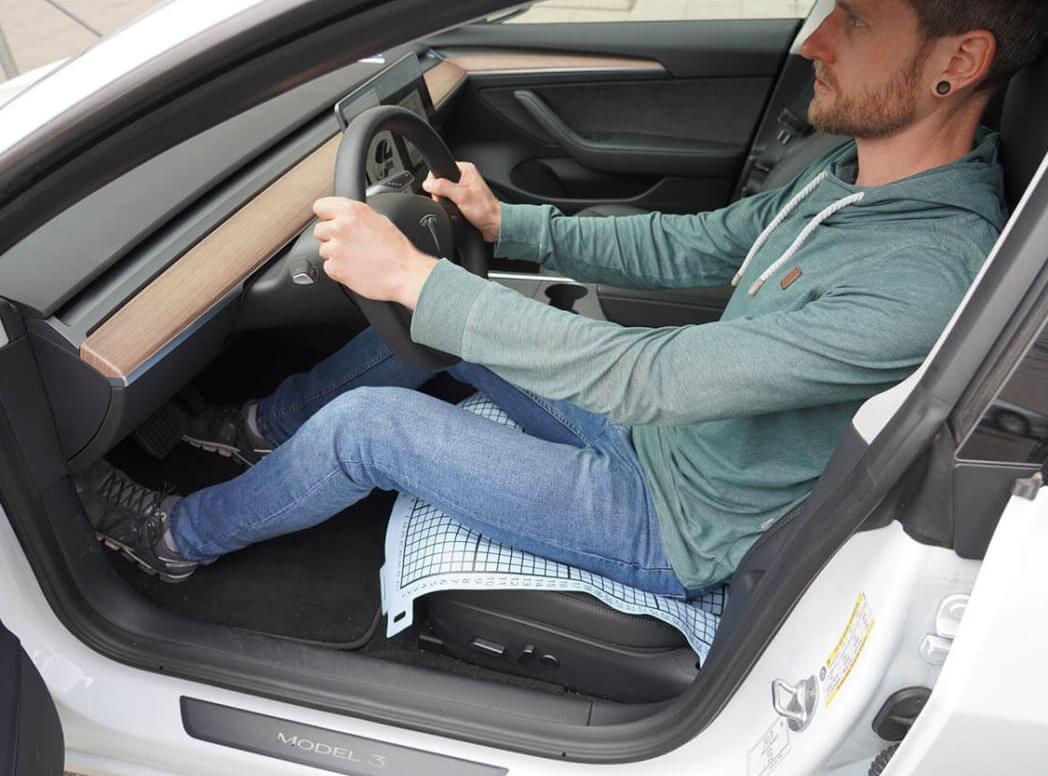
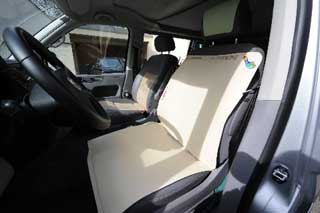
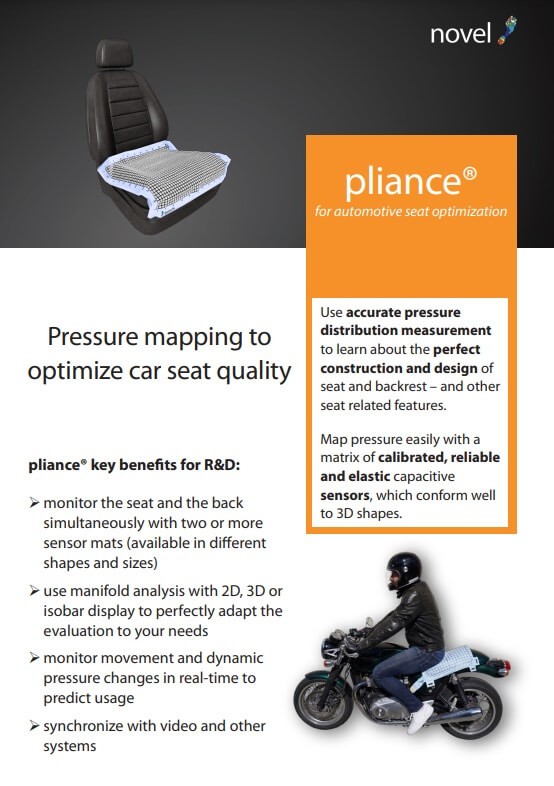
The novel pliance car seat measuring system is today a standard tool in the automotive industry. This system consists of a flexible and elastic measuring mat, multi-channel analyzer, calibration device and software package for PCs.

The measuring mats come in various sizes, sensor configurations and force ranges. The analyzers vary from small portable 16x16 sensor-matrix types to large 32 x 64 sensor matrix types with a wide range of options, such as master-slave synchronisation of several systems, dynamic amplification control and many other.


S2085, S2028: car seat belt, car seat and backrest sensors.

S2028: car seat and car backrest sensors

S2020: car steering wheel sensor

S2001: socket sensor (opening car door)

S2012: single sensor (opening car window)

S2028, S2020: car seat-backrest and headrest sensors

S2020: Elastisens HA125 (headrest sensor)

S2028: car seat and backrest sensors

online display for record and play

novel database pro i

novel report


The calibration device can be used at any time to verify the quality of the measuring results. It uses homogeneous air pressure on all sensors through increasing steps of pressure. Thus an individual calibration curve for each sensor can be calculated. The software operates in a Windows environment and contains many useful methods of data collection and scientific analysis of dynamic pressure. It also allows continuous memory of data.

The system transmits the data wireless via Bluetooth technology to the notebook. For mobile tests even pocket PCs can be used. As in all physical measuring systems the most important part is the sensor technology. pliance works with capacitive transducers in a matrix configuration. Because of the elasticity of the sensor mats they adapt perfectly to 3-dimensional deformations. The force transducing elements contain high-tech elastomers manufactured by novel. Restoring force, range of force, threshold, hysteresis, temperature effect, frequency response and other characteristics are determined during the manufacturing process. This makes it possible to adapt the sensor characteristic to the measuring application.


Together with the mat, the quality of electronic circuitry is also important. Particularly, the stability of the analogue amplifiers, the type of signal conditioning and the processing algorithms can dramatically influence the accuracy of the system.

novel developed a new analyser technology that allows not only individual calibration curves for each sensor, but also individual dynamic amplification control and cross talk suppression, resulting in very accurate and reproducible pressure values. Physiological artefacts that always occur in seat measuring are no longer hidden by technical artefacts.


Features

  • connects via Bluetooth or fibre optics cable to the PC
  • measurements can be also stored in the internal flash memory
  • operates with Win XP and Vista
  • measures highly accurate calibrated values
  • works with highly elastic sensor mats
  • conforms well to 3-D surfaces
  • comes with an air pressure calibration device
  • allows configuration of sensor matrix by software
  • scans with a speed of 20,000 sensors per second per analyzer
  • can be synchronized to video and EMG systems
  • is fully compatible with all novel analysis software

pliance is manufactured by novel, the leader in accurate PDM.

More information

biathlon test at University Salzburg

A custom designed novel pliance sensor array is used by the University Salzburg  to monitor the positioning and stability of the riffle in Biathlon sports. A combination of montion analysis, pressure distribuion measurement and EMG.

The work is in progress.

Universität Salzburg
Fachbereich Sport- und Bewegungswissenschaft/USI
www.olympiazentrum-salzburg.at

alpine and nordic testing

sensors integerated into alpine
or nordic ski


sensors measuring Tibia shaft
and plantar pressure


sensors measuring Tibia shaft
and plantar pressure


sensors measuring Tibia shaft
and plantar pressure


biofeedback systems for balance tests
during gliding


biofeedback systems for balance tests
during glidin


nordic ski boot testing


nordic ski stick testing


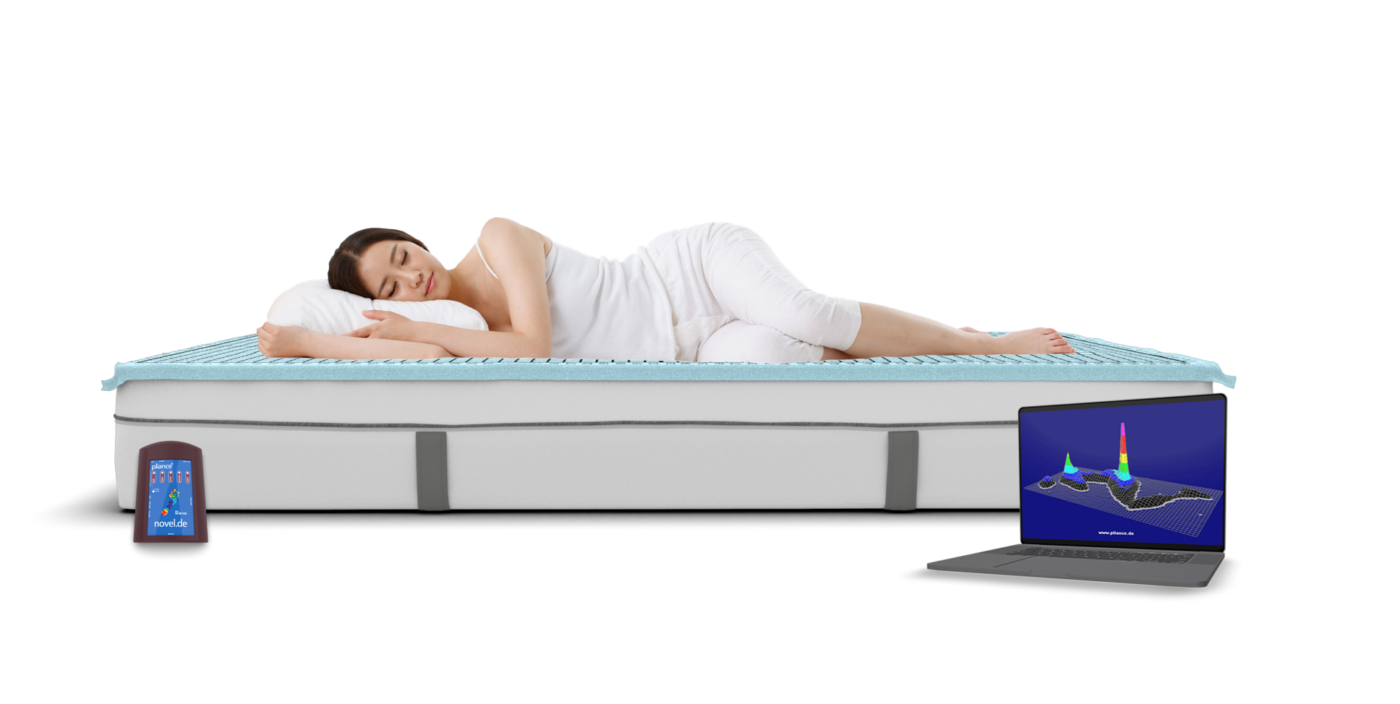
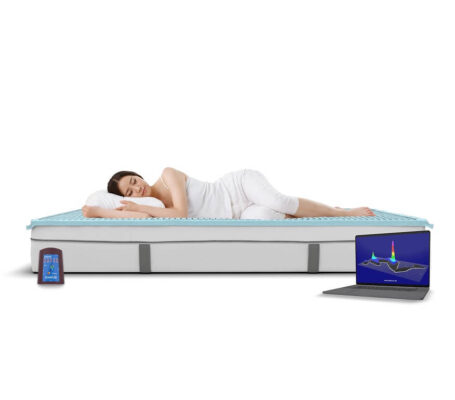
new development: a large size bed rest sensor mat

 novel  has developed a large size bed rest sensor mat that covers the full area of a mattress. The mat is highly elastic and conforms perfectly to the surface of a mattress under body load. As with all novel systems the sensors are calibrated accurately to the pressure range obtained during body contact.


piano player

In preparation of a new "art in science" project, novel took preliminary measurements of the individual forces exerted whilst striking the keys of a piano.

For the data collection the German concert pianist Henriette Gärtner played the introductory tunes of Schubert's "Wandererphantasie".


large area sensor mat


accelerator pedal


break pedal


x-country ski on skimat